
LabChart

  • Intro
  • Highlights
  • Features
  • Setup
  • Analysis
  • Display

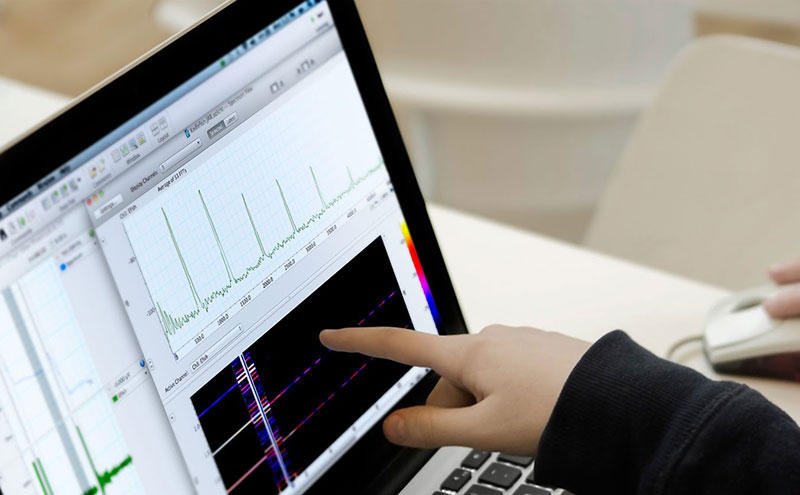
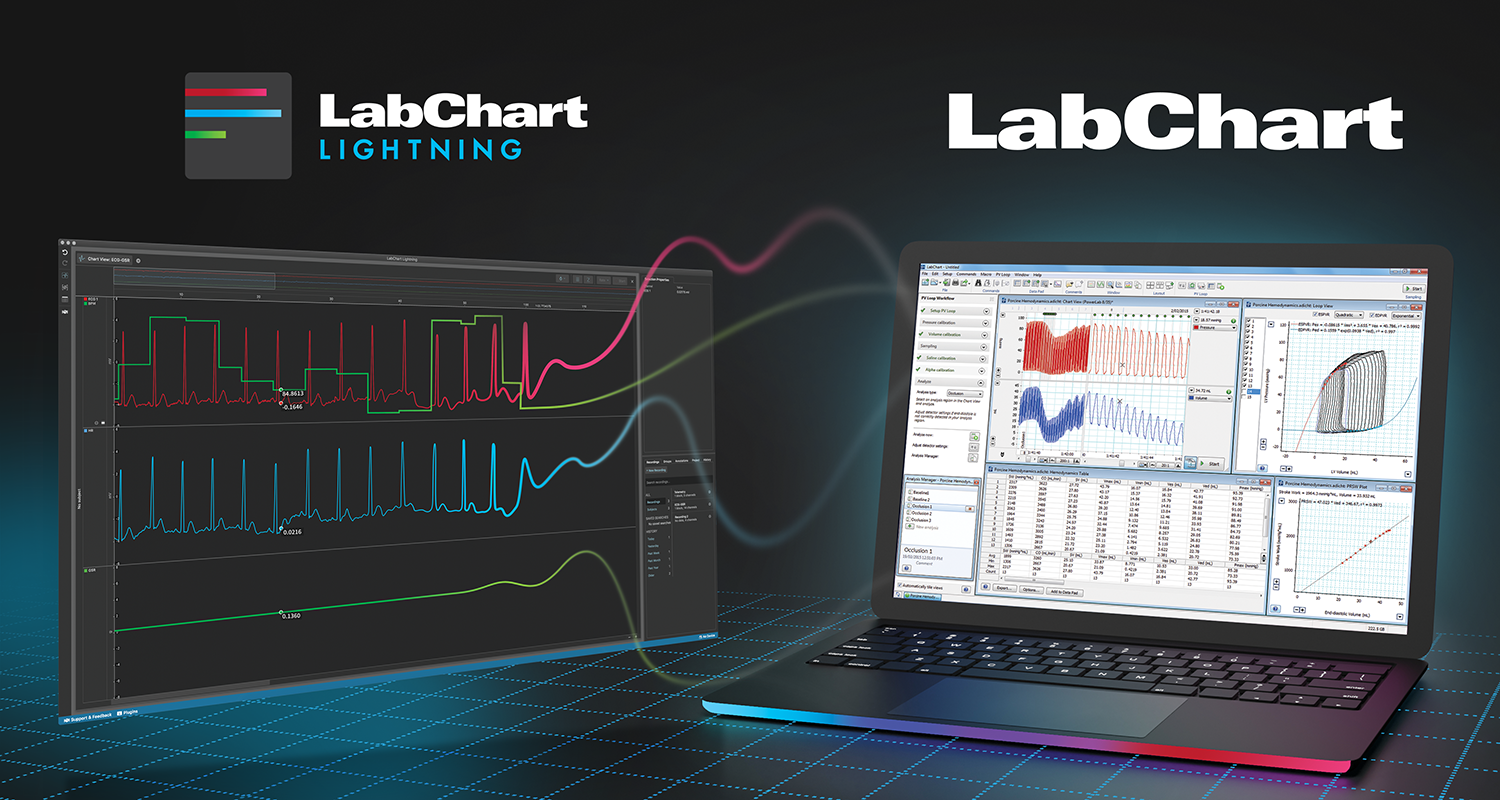
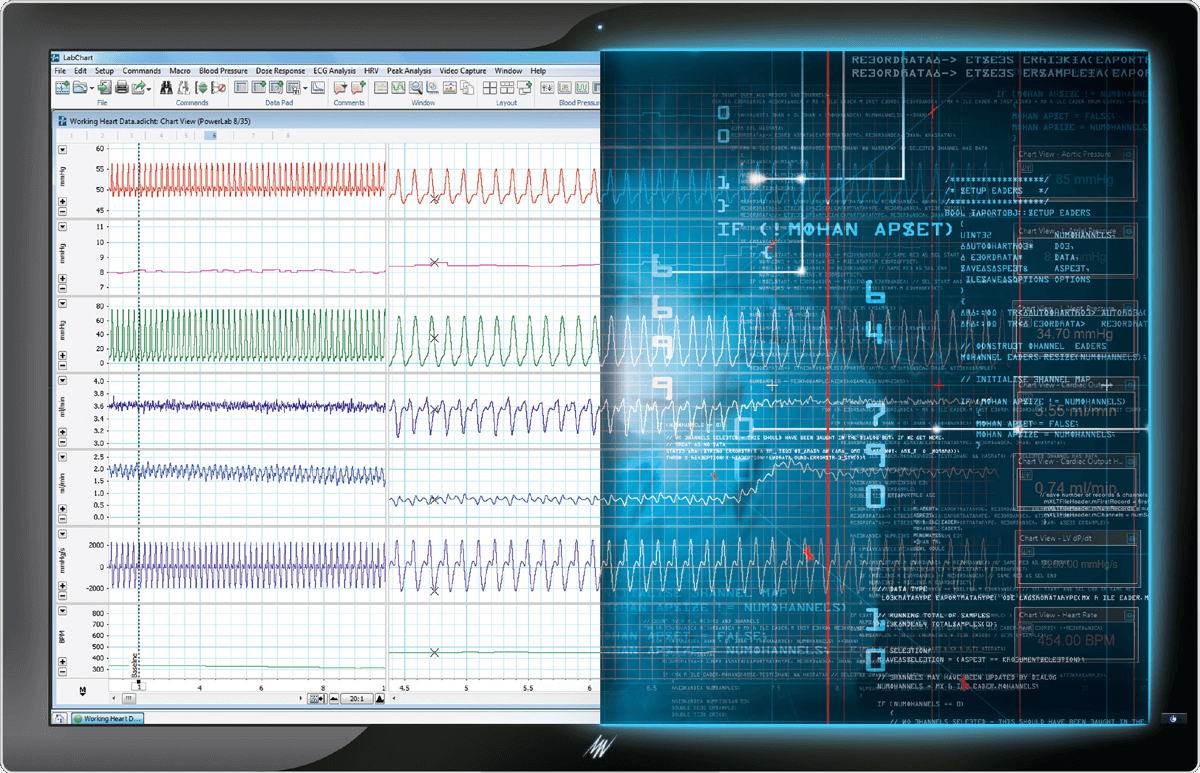
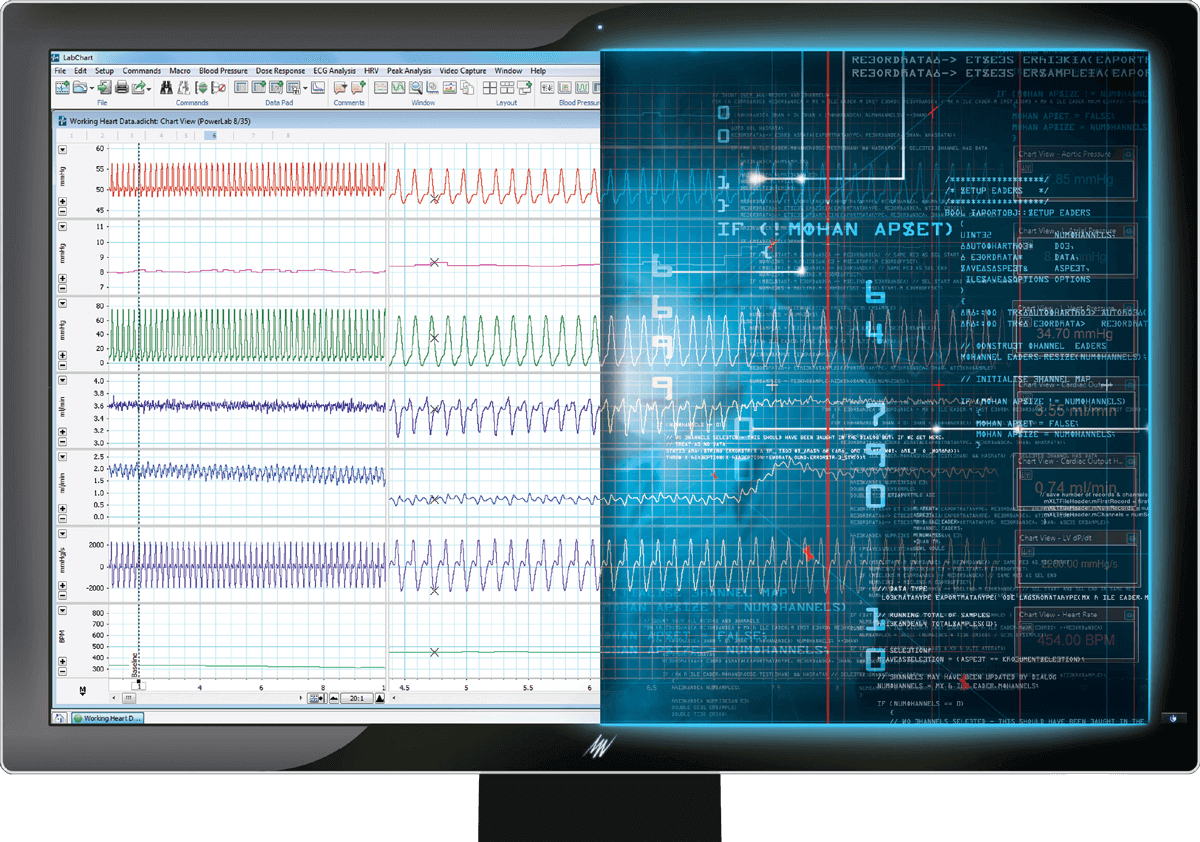
LabChart software combines the familiar simplicity of a traditional strip chart recorder and oscilloscope with the powerful analysis features of a digital acquisition system.

In conjunction with a PowerLab data acquisition unit, LabChart software (for Windows and Macintosh) provides the data integrity, display and analysis features needed for today's science. LabChart offers easy selection of hardware settings, powerful online and offline analysis, procedure automation, seamless extraction of experimental data and clever display options. You can extend LabChart's acquisition and analysis functions to suit specialized areas with LabChart Extensions and LabChart Modules, as well as share data with your colleagues using LabChart Reader. See also LabChart Pro.

LabChart 7.3 is the latest version of Chart software.

What's new in LabChart

LabChart 7.3 Highlights

See the key features in LabChart 7.3 for Windows and 7.2 for Macintosh.

Quick set-up and ease of use

Quick Set-up and Ease of Use

Start recording experimental data seconds after opening the LabChart program.

Favorite features

Favorite Features

Read about the favourite features of LabChart as voted by customers and staff.

Powerful data analysis

Powerful Data Analysis

Calculations, measurements, extraction of data, application specific tools and more.

LabChart Movie

LabChart In Action

Watch our selection of software movies to get a clear idea of LabChart's capabilities.

User friendly displays

User Friendly Displays

Use clever display features to help analyze, export contents or simply print.

GLP & 21 CFR Part 11

The GLP Client and the GLP Server software provide PowerLab users with an easy and reliable data acquisition solution for a GLP and 21 CFR Part 11 compliant environment. The GLP software is only available for LabChart for Windows (not LabChart for Macintosh).

LabChart v7.3 Highlights

Version 7.3 of LabChart for Windows includes several great new features to improve the way you generate, log and analyze your data. A completely new Data Pad is included in LabChart 7.3, which boasts a new look and faster data analysis. Scope View now incorporates baseline subtraction, which allows for the removal of recurring features in a signal, while Spectrum View is able to stack and overlay PSD plots in a similar way to LabChart's Zoom View. LabChart 7.3 also includes support for the new Playback File extension, which lets you stream your existing files into LabChart, simulating a PowerLab capturing and recording data in real time.

New features in LabChart v7.3.4:

DVM windows with simple channel calculations & trending graphs

A settings button at the top-left of the DVM enables users to display raw data or calculated data (Average, Maximum and Minimum) as text, as well as a history graph showing trending of calculated data. DVM windows can display simple channel calculations (the average, minimum and maximum channel values) over a specified time window.

DVM

Macros feature event-driven VB Scripting

Advanced LabChart users with VB Scripting knowledge can now set up Macros to operate continuously in real time until explicitly stopped by the user, efficiently responding to events as they occur in LabChart.

When a new macro is classified as an "Event Script", a new Events Pane is shown by default in the editor. Dragging events from the pane into the editor creates skeleton script code to handle the event.

Supported events include:

  • On sampling start
  • On sampling finish
  • On samples arrive
  • On event data arrives
  • On guide line crossed
  • On key pressed
  • On LabChart Selection changed
  • On external trigger
  • On Data Pad cell selection changes... and more!
Event Scripting

Arithmetic Dialog now includes a preview pane

LabChart Arithmetic allows users to perform mathematical expressions on data channels, including trigonometric functions, logarithmic functions, noise and filtering functions. The Arithmetic dialog in LabChart 7.3.4 lets you preview the effect of those expressions on your data before you apply it to the raw data.

Arithmetic Dialog

Data Pad

Access to Data Pad formulae is now quicker with the aid of the new Cell Formulae button located in the toolbar. You can toggle between cell values and the underlying formula, as well as retain all of the cell formulae when copying Data Pad sheets to Excel.

Data Pad

Improved Text Import options

You can now import text in a variety of formats with the file size only limited by the capabilities of your computer.

Supported files include:

  • Legacy Scope files
  • Text files
  • Acqknowledge
  • WinDAQ
  • Axon PCLAMP
  • Binary
  • European Data Format files.

Support for Wii Balance Board

The Wii Balance Board Extension –available form the Feature Manager - for LabChart facilitates communication between a Wii Balance Board and LabChart over a wireless Bluetooth connection. When installed, LabChart will automatically recognise the Wii Balance Board on startup.

The Wii extension is ideal for studies of static posturography. There are four load sensors in the Wii Balance Board and data from each sensor is acquired on a different channel. You can easily combine these four channels to calculate parameters such as weight and centre of gravity.

Wii Board

New LabChart v7.3 features:

  • New Data Pad (win only) - LabChart 7.3 features a completely new Data Pad, built from the ground up and powered by the new ADInstruments Spreadsheet Engine. The Data Pad has a fresh new look and a number of feature and performance improvements.


The user interface of the Data Pad sports many enhancements, both cosmetic and functional. Frequently used Data Pad functions are easily accessible from a group of drop-down menus. Undo and Redo now exists for all operations in the Data Pad, and all settings associated with the Data Pad can now be saved.

The new Data Pad also provides greater compatibility with other Windows applications. For example, there is now full Unicode support to ensure symbols are faithfully copied from other programs. OLE allows LabChart for Windows users to export data from the LabChart window or the Data Pad to Microsoft Excel or any OLE compatible software. Any changes in LabChart can be set to automatically update data in Microsoft Excel.

Many "under the hood" features have been incorporated into the completely re-written Data Pad to make use of new computing technologies. Parallel processing (multithreading and multi core support) has been widely implemented to speed up column calculation operations and to make the user interface more responsive. Previous versions of the Data Pad supported a maximum of 16000 rows. This restriction no longer applies and the number of rows available is only limited by the size of your computer's memory.

Data Pad provides a powerful and easy means of extracting experimental data:

  • Users can log any raw or calculated signal from any channel into the Data Pad.
  • The addition of values can be automated prior to recording using 'Timed Add to Data Pad'.
Data Pad provides a powerful yet easy means of extracting experimental data. Users can log any raw or calculated signal from any channel into a table.


  • Background Subtraction in Scope View - Scope Background subtraction is a new feature added to the Scope View which allows you to remove periodic signals, enabling further analysis. This is achieved by specifying a particular Scope view page as 'background' which is then subtracted from all pages in the file.

    Background subtraction can be applied to all channels, or a subset specified by you, and can be toggled on and off without losing the current background settings. Scope's background subtraction is dynamic - whenever the background data changes (for example, a smoothing calculation is applied) all other pages are updated automatically. You can also extract the background-subtracted numbers in the Data Pad and export them to a separate data or text file.
  • Stacked PSD Plots in Spectrum Window - Power Spectrum Density traces in Spectrum View can now be viewed as a stack in separate panes, as well as a single pane where the traces are overlaid. Plot stacking allows you to easily compare spectra of different magnitudes.


  • Updates to the Welcome Center - The Welcome Center's Recent Files list is now searchable by filename. This makes it easy to quickly recall your recently-used files from the list. A group of quick links has been added to the Welcome Center to provide easy access to LabChart features and extensions, and explore the comprehensive help, web support and training opportunities that ADInstruments has available.


  • Playback File Support - The Playback File LabChart extension in now available for LabChart 7.3. This powerful new feature allows data from existing LabChart files to be streamed in real time during recording, just as if the data were coming from an attached device. This allows you to mimic real-time recording situations using previously recorded data. Playback File makes it perfect for in-class demonstrations where you might not have all of the equipment available, but want to simulate real-time PowerLab sampling.

Playback File is installed as a virtual recording device, so can be used by itself as the only device connected to LabChart, or in combination with any other devices such as a PowerLab. Any file that is recognized by LabChart can be used as a data source. This includes imported file formats such as EDF and MATLAB, and audio formats including WAV, FLAC and OGG. Playback File sources can be streamed at their native sample rate or even resampled to rates commonly used by LabChart. Any channel calculations present within the file are generated as source data.

The Playback File extension for LabChart 7.3 is available from within the Feature Manager.

Other recently added features:

  • Sampling from Multiple Devices (Win only) - You can record a maximum of 32 channels of live data using multiple PowerLab units and a BioHarness into a single LabChart file. This has two major benefits: being able to increase the number of raw data input channels and a convenient way to analyze data from multiple subjects or recordings. The Devices and Channels dialog provides a quick and easy way to configure available devices.
Devices and ChannelsThe Devices and Channels dialog enables the selection and configuration of available devices


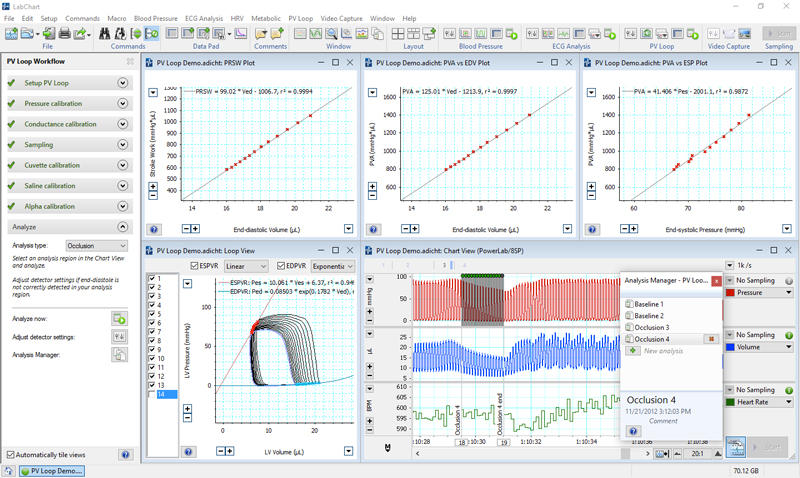
  • Analysis Manager (Win only) - You can use Analysis Manager in conjunction with LabChart modules to save the analysis settings associated with any number of data regions. This enables analysis of separate data regions within a data file, multiple analyses of the same or different data regions, and the results of each analysis to be saved and recalled. The Analysis Manager can also be used with LabChart alone to save and recall selections of data and/or active points in both Chart and Scope View.
Analysis ManagerThe Analysis Manager dialog showing 8 saved analyses.
Saved analyses can be recalled, revised or deleted


  • Continuous Auto Scale - LabChart can now continually re-scale the vertical display in Chart View channels online (while sampling) or offline (while scrolling). This feature dynamically adjusts the signal to the available display area.
Continuous Auto ScaleContinuous Auto Scale ensures the signal stays viewable even after a large change in the signal magnitude, as seen on the right of the above screen capture.


  • Integration of Export, Import and Translate Extensions(Win only) - All Export, Import and Translate extensions (with the exception of Export QuickTime) are now available in LabChart as a standard feature. These include:
    • Export IGOR, Export MATLAB, Export WAV
    • Read AcqKnowledge
    • Read WAV, Read WinDAQ
    • Translate Axon, Translate Binary, Translate EDF


  • New Read Wav and Read WinDAQ Extensions (Win only) - Part of the newly integrated Export, Import and Translate extensions, WAV and WinDAQ files can now be imported into LabChart. These file types are available from the Open dialog in the File drop down menu.
File FormatsThe Open dialog listing available file formats.
  • Event markers now able to be exported separately from comments (Win only) - You now have the choice of exporting event markers separately in the Export as settings dialogs.
Save as SpectogramThe Save as Spectrogram Text File option in the Save As dialog.
  • New Data Pad Calculation (Win only) - End Value - Start Value calculation provides the difference between the start and end values of a selection.
    • Welcome Center - Centralized access to LabChart related files for quick and easy access. ADIPak mechanism (Windows only) allows packaging and installation of LabChart files and supporting documents into Welcome Center Gallery to be shared with colleagues, collaborators or students. An ever-increasing number of Help Tutorials are available in the Welcome Center (Windows only).
Welcome CenterWelcome Center
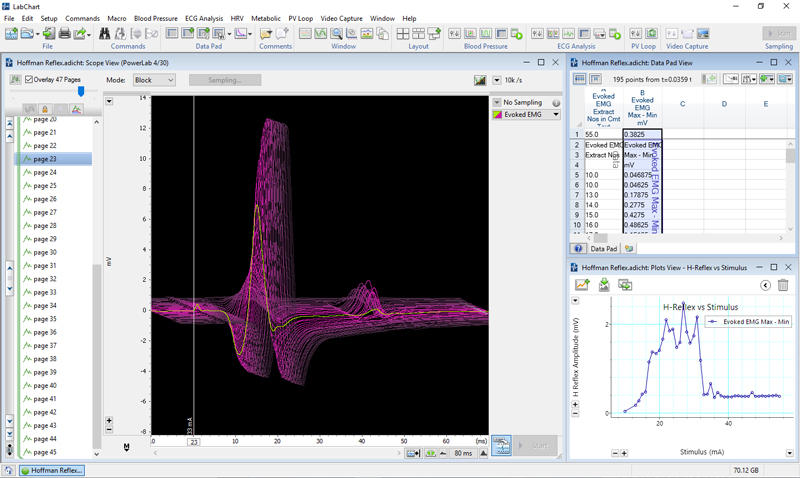
    • Scope View (Win only) - An additional software oscilloscope view of LabChart data. Averaging and sampling settings can be easily configured from the Scope View. Pages or sweeps can be generated using data blocks, events or comments in LabChart View. Recording of data occurs simultaneously into the Scope and Chart Views. Scope View provides a number of powerful tools to enhance analysis and display, and improve trace contrast. These include the 3D Depth Overlay feature, Scope Overlay Options dialog box and Black Background toggle.
Scope View OverlayScope View showing the Scope Overlay Options dialog and a black background


    • Spectrum View (Win only) - Allows analysis of frequency distribution of component sine waves with Power Spectral Density (PSD) and Spectrogram plots. Plots can be viewed in online or offline modes. The spectrum parameters can be continuously displayed in LabChart channels and exported to Data Pad.
Spectrum ViewThe PSD and Spectrogram plots


The spectrum parameters can be continuously displayed in LabChart channels and exported to Data Pad.  Spectrum parameters include:
  • total power
  • percentage total power
  • maximum power
  • minimum power
  • maximum power frequency
  • minimum power frequency
  • mean power frequency
  • median power frequency
  • standard deviation frequency
  • spectral edge frequency
Spectrum HighlightChart View and Data Pad with exported Spectral parameters (left)
and Spectrum PSD and Spectrogram plots (right)


    • New Stimulator (Win only) - Provides complete control over stimulation patterns, frequency, duration and triggering options. Two independent stimulus outputs can be generated simultaneously.  Preconfigured stimulus waveforms available include Arithmetic, Pulse, Step Pulse, Biphasic Pulse, Double Pulse, Ramp, Sine and Triangle.  You can also generate and save custom stimulus waveforms.
Stimulator HighlightUse preset waveforms, or customize your own


    • Feature Manager - Browse and obtain any of ADInstruments software from one interface. Software updates can be manually or automatically performed to alert you about new versions of LabChart, LabChart Extensions and LabChart Modules.
Feature Manager
    • Improved Help Center (Win only) - LabChart 7 'Help Center' now distinguishes between online software and hardware PDF documentation. Most LabChart Modules now come with a 'Getting Started Tutorial' to guide you through each module's features using either your own data file or a supplied sample data file.
Help Center
    • Digital Output Extension - The Digital Output Extension is now a standard feature in LabChart 7 for the management and control of digital output lines used to trigger devices such as stimulators or heating baths (eg PowerLab® 26T, /30 series, 4/SP, 8/SP, 16/SP and 4/ST series)

      Download Tip  Download: Digital Output Software Tip(130 KB)

    • 'Save as Settings' Option - It is now easier than ever to save the settings from a LabChart document. Settings files are easily accessible via LabChart7 Welcome Center.
       
    • 'Cyclic Measurements' for Windows and Macintosh - 'Cyclic Variables' in Macintosh is now replaced with 'Cyclic Measurements'. 'Cyclic Measurements' features a wide range of statistics and functions to analyze periodic or cyclic signals. Calculations include rate, period, frequency, mean, minimum, maximum, 1/3 maximum + 2/3 minimum, height, integral, variance, minimum derivative and maximum derivative
Cyclic Measurements
    • Select/Every Option for 'Time Add to Data Pad' (Win only) - The new Select/Every option available in 'Time Add to Data Pad' provides greater flexibility when making selections during recording. In addition, data selections around Scope events can be made using the new Scope mode.
Timed add to data pad


For more information, or an obligation-free demonstration of the PowerLab data acquisition system including LabChart software, contact your local ADInstruments representative.

Please note that software features may differ between the Windows and Mac OS versions of LabChart. See the Software Updates page for more information on the latest versions.

1234567891011121314151617181920212223242526

Welcome Center

Welcome Center: Gain access to LabChart resources and materials within one interface. Open your LabChart files, access all ADInstruments documents (including demo files and supporting documents), clone document settings easily as well as access and search up to 100 recently opened files.

Welcome Center Highlight

Start recording experimental data just seconds after opening LabChart.

Sampling from Multiple Devices

You can sample from multiple PowerLab units and a Bioharness system into one LabChart data file. This has two major benefits: being able increase the number of raw data input channels and a convenient way to analyze data from multiple subjects. Selecting the available devices (including the master device) and configuring the input channels is quick and easy.

The Devices and Channels dialogThe Devices and Channels dialog (above) allows you to select the number and type of device you are recording data from and configure the input channels.
Chart ViewChart View, showing 12 live sampling channels from 3 devices

Welcome Center

The Welcome Center for LabChart 7 provides structured, easy and quick access of LabChart resources and materials. Features of the Welcome Center include:

    • Gallery Panel: Access to ADInstruments resource files or user-defined files
    • The ADIPak mechanism integrates with Windows Explorer to allow easy packaging and installation of content into Welcome Center. Creation of custom ADIPak files is simple. Files can be easily shared with colleagues, collaborators or students.
LabChart 7 Welcome CenterWelcome Center showing the Recent Files Panel and Getting Started content

    • Recent Files Panel: Up to 100 recently assessed files can be displayed. You can choose to open any of the files, clone settings from a file or open a new document. The list is now also searchable by filename. This makes it easy to quickly recall your recently-used files from the list. A group of quick links has been added to the Welcome Center to provide easy access to LabChart features and extensions, and explore the comprehensive help, web support and training opportunities that ADInstruments has available.

Download Tip
        
Download: Welcome Center Software Tip(268 KB)


ADIPak Creator DialogADIPak Creator Dialog showing the easy one-step process to package data files and other LabChart resources

Input Amplifier

In the Input Amplifier window you can:

      • Preview an incoming signal and optimize data collection parameters
      • Select an appropriate range
      • Shift and stretch the vertical amplitude axis to make the best use of the available display area
      • Remove unwanted drift and noise with high pass and low pass filters
      • Change the polarity of the signal and display the offset
Input Amplifier DialogInput Amplifier Dialog

Easy Units Conversion

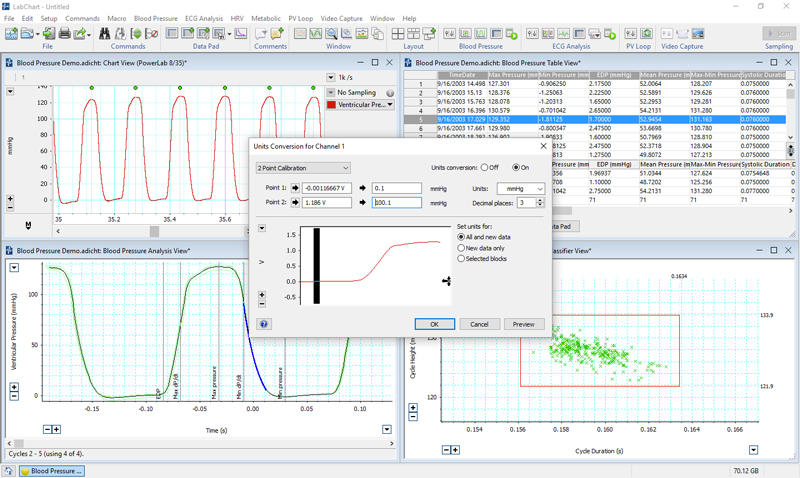
Convert the input voltage signal to useful units using the Units Conversion dialog. Any signal can be viewed in units such as mA, mmHg, pH or g, or as a custom defined unit, after performing a linear calibration. Different unit scaling can be applied to each channel. The unscaled raw data is always retained and available for recall at anytime. For non-linear sensors, multipoint calibration (up to twelve points) can be performed with the Multipoint Calibration Extension.

Units Conversion DialogUnits Conversion Dialog

Change Channel Settings in Seconds

LabChart offers 32 channels with variable sampling speeds. Use the Channel Settings dialog to set up multiple channels quickly from one location.

      • Label channels with titles
      • Turn channels on or off
      • Adjust the input range
      • Configure each channel's Input Amplifier dialog
      • Change the color of the data trace
      • Turn the channel separator on or off
      • Select channel calculations
The Channel Settings dialog allows access to a range of dialogs for quick and easy set up of channel parametersThe Channel Settings dialog allows access to a range of dialogs
for quick and easy set up of channel parameters

Triggering and Scope View Sampling

      Users can control how and when LabChart starts and stops recording using the triggering options in the Sampling dialog. You can use the controls to set up the type of trigger event, any delay before recording, how many times to repeat triggering and how multiple blocks in Scope View are handled. You can start and stop a recording using an external trigger source, stimulator or by setting a threshold voltage to trigger from one of the recording channels. Pre-triggering and post-triggering options are available.
The Channel Settings dialog allows access to a range of dialogs for quick and easy set up of channel parametersSampling dialog (left) and External Trigger Options (right)

Quick Stimulation Set-up

      The software-controlled Stimulator allows you to generate a stimulus or series of stimuli from the PowerLab analog outputs. Using the PowerLab 30 series units, two independent stimulus outputs can be generated simultaneously. The second output can be set up easily on the Output 2 tab on the Stimulator dialog.
The Channel Settings dialog allows access to a range of dialogs for quick and easy set up of channel parametersThe Stimulator dialog - Output 1 and Output 2

Stimulator Dialog

      You can select the stimulation waveform's patterns, frequency, duration and output range.
The Channel Settings dialog allows access to a range of dialogs for quick and easy set up of channel parametersStimulator dialog

Preconfigured stimulator waveforms

      The Stimulator dialog contains a variety of preconfigured stimulus waveforms.  These include Arithmetic, Pulse, Step, Step Pulse, Biphasic Pulse, Double Pulse, Ramp, Sine and Triangle.


Custom Stimulus Waveforms

      Custom stimulus waveforms can be generated by selecting and configuring any combination and number of stimulus segments.  All customized waveforms can be saved for future reference.
The Channel Settings dialog allows access to a range of dialogs for quick and easy set up of channel parametersGenerate and save custom stimulus waveforms

Easy Access Stimulator Panel

      Once the stimulation parameters are set up in the Stimulator dialog, you can easily start or stop stimulation, and change the settings while sampling using the Stimulator panel.

The Stimulator panel floats in front of the active LabChart View window and can be moved around the screen. It gives you quick and easy control of stimulation parameters, including frequency, duration and amplitude for all outputs that are being used.

Stimulator Panels Stimulator Panel


Feature Manager

You can browse and obtain any of ADInstruments software from one interface. Features include:

      • Product panel: The entire catalogue of LabChart software is listed. Choose your product and click the "Get" button to automatically download and install the software.
      • Category panel: LabChart software is grouped into general and scientific application categories.
      • Information panel: Describes the major features and functions of the selected product.
      • Schedule/Check for Updates: checks for the latest software updates, either manually or automatically at daily, weekly or monthly intervals.
      • Register: Registered PowerLab users have free access to ADInstruments software updates, LabChart Extensions, teaching experiments, application notes and other special offers.
      • Search: Feature Manager will find suitable LabChart software based on keywords typed in the Search box.
Feature Manager DialogBrowse and obtain ADInstruments software from the Feature Manager Dialog

Download Tip  Download: Feature Manager Software Tip (222 KB)


For more information, or an obligation-free demonstration of the PowerLab data acquisition system including LabChart software, contact your local ADInstruments representative.

Please note that software features may differ between the Windows and Mac OS versions of LabChart. See the Software Updates page for more information on the latest versions.

Data Analysis: Advanced calculations, measurements, data extraction, application specific tools and more.

To experience a selection of LabChart's data analysis features, download this rabbit ECG data file( 76 KB ). The file can be opened in LabChart or LabChart Reader. LabChart Reader is available as a free download.

Analysis Manager

The Analysis Manager is supported by the latest version of popular LabChart Modules and LabChart alone. It allows you to save and recall:

  • A selection of data and its horizontal position in Chart and Scope Views.
  • An active point and its horizontal position in Chart and Scope Views.
  • Settings from Module settings dialogs.
  • One or more regions of analysed data and the horizontal location in Chart and Scope Views.
  • Multiple analyses of the same or different regions made with modules.
  • Selections from the Module menu (i.e. 'show cycle markers').
  • Selections made in a module view or table (i.e. regression information, parameters displayed).
Spectrum View SettingsThe Analysis Manager dialog box showing 8 saved analyses.
Saved analyses can be recalled, revised or deleted.

Spectrum View

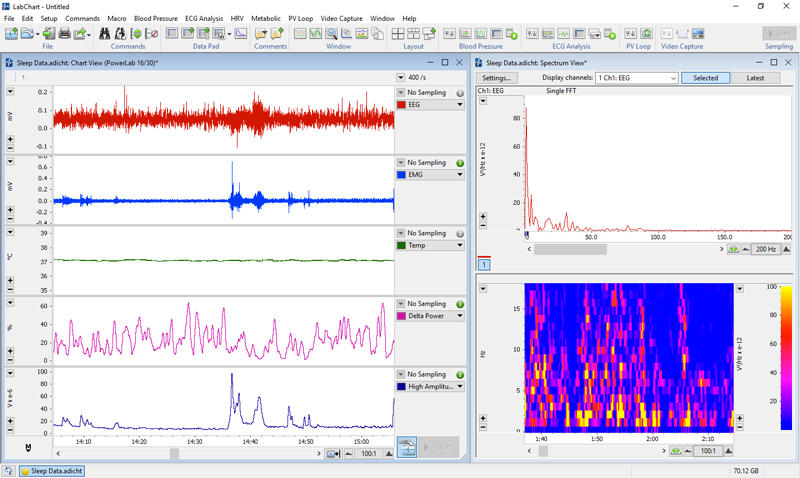
The Spectrum View is a powerful tool to display and analyze the component frequencies of a signal.  The spectral analysis is represented graphically with the Power Spectral Density (PSD) and the Spectrogram plot. The PSD and Spectrogram panes can be displayed individually or together, in online or offline modes. You can view PSD traces in separate panes (stacked) or overlay the traces for quick and easy comparison.

Spectrum is frequently used to isolate electrical noise components or distinguish component waveforms within a signal such as Alpha, Beta, Delta, Theta and Gamma waveforms within an EEG.

Spectrum ViewSpectrum View with PSD (top) and Spectrogram (bottom)

Power Spectral Density (PSD)
PSD displays the power of the input signal over a selected frequency range.  Single or multiple signals can be analyzed. Data from multiple channels are overlaid on the PSD plot. The example above shows two signals being represented in red and blue. 
Spectrum View settings allow the selection of:

  • The size of FFT calculations, which affects the frequency resolution.
  • The type of data window, reduce artifacts due to non-periodic data.
  • The extent of window overlap to increase the accuracy
  • Amplitude zeroing of the first frequency component.

Several PSD display modes are available, including:

  • Amplitude
  • Power
  • Power Density
  • Power Attenuation (decibels)
  • Stacked or overlaid PSD traces.
Spectrum View SettingsSpectrum View PSD showing calculations and display modes

Spectrogram
The Spectrogram displays a false colour coded plot of signal spectral power against time and frequency.  Separate Spectrogram plots are used to display each selected channel.  You can easily select the colour scale of the Spectral power trace.

SpectrogramSpectrogram showing color display options

Spectrum parameters can be continuously displayed as signal in LabChart using Channel Calculations. Parameters of interest can be also periodically exported the Data Pad.

Continuous DisplayContinuously display spectrum parameters. Several calculation types are available in Spectrum Channel Calculations.

Data PadExtracting Spectrum parameters to the Data Pad


Analyzing Data with Data Pad

Online:

Raw signals or calculated values from any channel can be extracted and logged into a table using the Data Pad, powered by the ADInstruments Spreadsheet Engine. Designed and purpose-built by ADInstruments software architects it features parallel processing and full Unicode support for unmatched speed in data logging, analysis and export. The number of Data Pad rows is unrestricted, and you can add multiple sheets of data for analysis.

You can automate the addition of values prior to recording by using the 'Timed Add to Data Pad' feature. This feature periodically logs extracted parameters to the Data Pad while data is recorded. 'Timed Add to Data Pad' in conjunction with LabChart OLE linking allows real time plotting of X-Y curves in Excel for qualitative linear regression analysis.

Data Pad WindowTimed Add to Data Pad Dialog with LabChart OLE linking allows real time plotting of X-Y curves in Excel

Offline:

You can also select the data of interest after it has been recorded by simply choosing the 'Add to Data Pad' command. The 'Multiple Add to Data Pad' feature can also repeatedly extract values from data already recorded.

Data Pad contents can be saved as a text file, Excel file (Win only) or can be copied to other programs. Using OLE you can also export incoming values to Excel and other programs in real time.

Analysis options include:

  • Statistics

    - calculate the mean, SD, RMS, max and min value, time at max and min values and number of points
  • Selection & Active Point

    - obtain the start time, end time, duration and number of points
  • End Value - Start Value

    - provides the difference between the start and end values of a selection.
  • Comments

    - list time or value of active points, comments and comment numbers or times
  • Slope

    - get the average slope value, max and min slope or time at max and min slopes
  • Integral

    - calculate time integrals online or offline
  • Block Information

    - obtain the range, sample interval, block number, block duration, samples in block, start time, start date and sampling rate
  • Cyclic Measurements

    - extract periodic parameters from waveforms including frequency, rate mean, min and max, 1/3 max + 2/3 min, height, integral, variance, max and min derivatives
  • Scope

    - obtain page number, page duration and page start time containing the active point or selection from Scope View
  • XY Loop Calculations

    - calculates the area inside the XY loop, x or y value and slope at the reference point in XY loop, minimum and maximum x or y value, time at minimum and maximum x or y value, and mean of x or y value in XY loop in the XY View

Incoming or already recorded values can be exported in real time using OLE client programs such as Excel and Word. The link from LabChart to Excel can be made dependent so that any change to the data selection in LabChart will automatically update the values in Excel. OLE is available from the LabChart View mode as well as from the Data Pad.

Data Pad WindowData Pad Window

Download Tip  Download: Timed Add to Data Pad Software Tip(103 KB)


OLE Linking with LabChart for Windows

Incoming or already recorded values can be exported in real time using OLE client programs such as Excel and Word. The link from LabChart to Excel can be made dependent so that any change to the data selection in LabChart will automatically update the values in Excel. OLE is available from the LabChart View mode as well as from the Data Pad.

OLE allows data to be updated and acquired online or offline into other software programs including ExcelOLE allows data to be updated and acquired online or offline
into other software programs including Excel

Finding Data

The Find and Select feature allows you to quickly find specific points of interest within a data file. Set up your required search and selection criteria and search any number of channels for:

  • comments
  • waveform peaks
  • waveform troughs
  • block boundaries
  • maximum or minimum values
  • and more
Finding DataFind data


Using the Marker Tool

You can make relative measurements of a waveform with respect to its position by dragging and locking the Marker at a point of interest on the waveform. By moving the cursor along the waveform, on either side of the marker, you can measure and display the relative time and amplitude at the cursor positions.

Marker tool used for making relative measurementsMarker tool used for making relative measurements

Channel Calculations

These options let you apply calculations to channels of recorded data online or offline. The following channel calculations are built into LabChart:

  • Arithmetic

    - - apply equations to channels, including math equations, trigonometric functions, logarithmic functions, noise and filtering functions. With the preview panel, you can review and refine the effect of these expressions on the data before they are applied to the channel.
  • Cyclic Measurements

    - analyze periodic waveforms to derive functions such as rate, period and frequency as well as cyclic mean, maximum, minimum and height.
  • Derivative

    - display the first and second derivative.
  • Digital Filter

    - select from six online or offline filter types: low-pass, high-pass, notch, narrow band-pass, band-pass and band-stop.
  • Integral

    - measure areas under waveforms.
  • Shift

    - shift data backwards or forwards in time.
  • Smoothing

    - remove unwanted high frequencies and noise from a waveform.
  • Spectrum

    - display Total Power, Percentage Total Power, Maximum and Minimum Power, Maximum and Minimum Power Frequency, Mean Power Frequency, Median Power Frequency, Standard Deviation Frequency and Spectral Edge Frequency.
Channel Calculations, using the raw data from channel 1, calculate heart rate, systolic, diastolic and mean pressure on other channels.Channel calculations use the raw data from channel 1 to calculate heart rate, systolic, diastolic
and mean pressure in other channels

Cyclic Measurements

Cyclic Measurements allows quick, easy and powerful processing of periodic waveform signals, online or offline, converting raw data from one channel to computed data displayed in another. The advanced detection and available presets allows users to simply select the signal type, drag the slider until all peaks are selected and click ok to start analyzing the the periodic data. The following calculations are available:

  • Rate

    - calculate rates e.g. heart rate from ECG.
  • Period

    - measure time taken to complete a cycle.
  • Frequency

    - calculate event frequencies.
  • Mean

    - derive the mean of a cyclic waveform.
  • Min, Max, 1/3 Max + 2/3 Min

    - use these, for example, to calculate the diastolic, systolic and mean BP from an arterial BP trace.
  • Height

    - calculate maximums minus minimum height.
  • Integral

    - measure areas under waveforms.
  • Variance

    - detect statistical variance of values within a given cycle of a waveform.
  • Min and Max Derivative

    - calculate minimum and maximum derivatives in a given cycle of a waveform.
  • Unit Spike at Events

    - place markers on a second channel where a peak occurs on the input channel.
  • Event markers now able to be exported separately from comments

    - you now have the choice of exporting event markers separately in the Export as settings dialogs.
Cyclic Measurements allows for online or offline analysis of waveforms.Cyclic Measurements allow for online and offline analysis of waveforms.

Macros

LabChart 7 allows editable macros with VB scripting in both Chart and Scope View. Use the Macro feature to:

  • Automate repetitive tasks such as extracting data, exporting data and adding comments
  • Change recording settings such as sampling rates and stimulus settings for different stages of an experiment
  • Create and/or import event-based scripts that run continuously until explicitly stopped by the user.
Editable macrosEditable macros – advanced scripting

LabChart Extensions

LabChart Extensions are available free of charge to all LabChart users and provide additional data formatting, filtering, visualization, measurement calculations and other utility features.

See the LabChart Extensions page for the complete Extension list for Windows and Macintosh.

Latest additions include:
  • Wii Balance Board Extension - facilitates communication between a Wii Balance Board and LabChart over a wireless Bluetooth connection. The Wii extension is ideal for studies of static posturography. There are four load sensors in the Wii Balance Board and data from each sensor is acquired on a different channel. You can easily combine these four channels to calculate parameters such as weight and centre of gravity.
    Playback File Extension - A powerful virtual recording device that streams data from saved LabChart files (source files) to live LabChart channels. It can be used alone as a single device connected to LabChart), or in combination with a PowerLab unit, to mimic real-time data acquisition. The source file can be streamed at its native sample rate, or resampled at rates commonly used by LabChart.
    Any file that is recognized by LabChart can be used as a source file (including imported file types) such as EDF, MATLAB, WAV, FLAC, OGG and more.
    Any channel calculations present within the source file are generated as source data. As well as allowing aggregation of data for research, is a cost-effective solution for simulating real-time PowerLab sampling in the classroom.
  • Integration of Export, Import and Translate Extensions - All Export, Import and Translate extensions (with the exception of Export QuickTime) are now available in LabChart as a standard feature. These include:
    • Export IGOR, Export MATLAB, Export WAV
    • Read AcqKnowledge
    • Read WAV, Read WinDAQ
    • Translate Axon, Translate Binary, Translate EDF
  • New Read Wav and Read WinDAQ Extensions - Part of the newly integrated Export, Import and Translate extensions, WAV and WinDAQ files can now be imported into LabChart. The filetypes are available from Open dialog in the File drop down menu.

LabChart Modules for Advanced Analysis

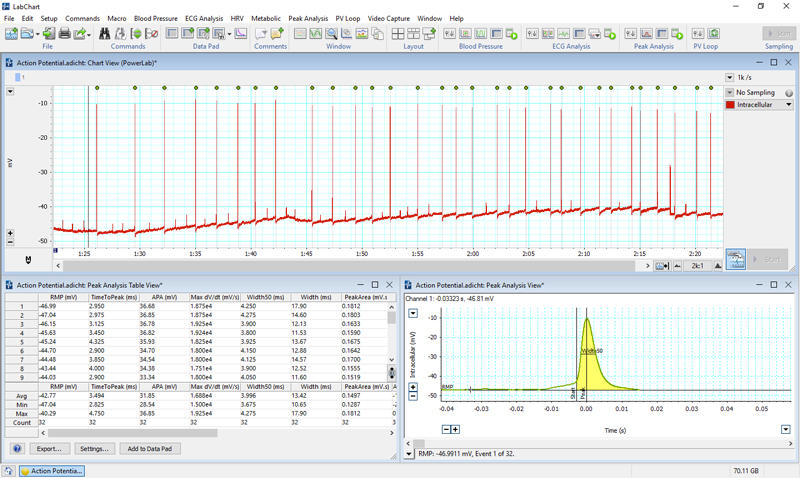
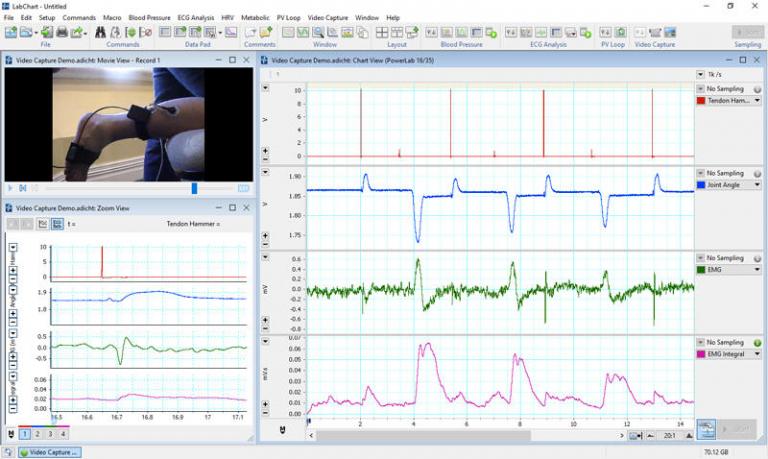
LabChart Modules provide specialized data acquisition and analysis features for specific applications.

Blood Pressure Module (Win)Heart Rate Variability Module (Win or Mac)
Cardiac Output Module (Win)Metabolic Module (Win or Mac)
DMT Normalization Module (Win or Mac)Peak Analysis Module (Win)
Dose Response Module (Win)Spike Histogram Module (Win or Mac)
ECG Analysis Module (Win)Circadian Analysis Module (Win)
Video Capture Module (Win or Mac)PV Loop Module (Win)

See the LabChart Modules page for more information, and visit our multimedia page to watch movies detailing the features of several Modules.

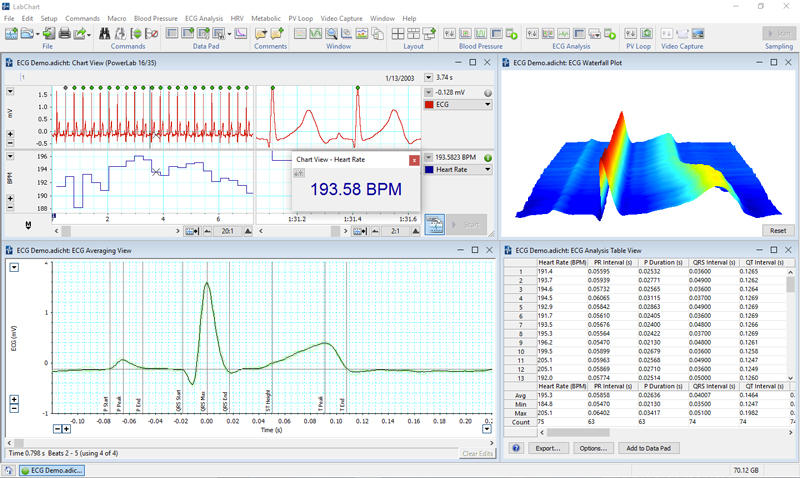
ECG Module's OverviewECG Module for Windows analyzes human and animal ECG signals.
Spike Histogram Module's Discriminator WindowThe PV Loop Module for Windows analyzes left ventricular pressure and volume data for hemodynamic research in animals.

For more information, or an obligation-free demonstration of the PowerLab data acquisition system including LabChart software, contact your local ADInstruments representative.

Please note that software features may differ between the Windows and Mac OS versions of LabChart. See the Software Updates page for more information on the latest versions.

Use clever display features to help analyze, export contents or simply print.

View Data Pad formulae

Access to Data Pad formulae is now quicker with the new Cell Formulae button located in the toolbar. You can toggle between cell values and the underlying formula, as well as retain all of the cell formulae when copying Data Pad sheets to Excel.

Data Pad Toggle between cell values and formulae in Data Pad

DVM windows with simple channel calculations & trending graphs

A settings button at the top-left of the DVM enables users to display data as text, as well as a history graph showing trending of calculated data. DVM windows can also display simple channel calculations (the average, minimum and maximum channel values) over a specified time window and can be resized to view from across the room.

DVM DVM settings and display

Continuous Auto Scale

The auto-scale button allows the user to automatically and continuously scale data for all displayed channels. You can continually auto scale the Chart View channels while sampling or viewing data. Continuous Auto-Scale dynamically adjusts the vertical scale of data in LabChart. It is particularly useful for recordings that show large changes in signal amplitude, or those with a shifting baseline as it allows you to have a detailed and scaled view of all signals without having to click the scale button frequently.

Continuous Auto Scale ensures the signal stays viewable after a large change in the signal magnitude

Customizable Toolbar

LabChart 7 Toolbar allows fast and easy access to LabChart features. Toolbar icons can be turned on or off by right-clicking over the Toolbar and checking/unchecking the desired features. Toolbar features include:

  • File

    – choose to create, open, save or print a document
  • Commands

    – open the 'Find and Select' dialog of 'Find Again' to perform a search, click to go to the start or end of a data file or rescale each Amplitude axis with the 'Auto Scale All Channels' option to make the maximum and minimum value of each data within the visible range
  • Data Pad

    – open the Data Pad window, Add to Data Pad, multiple Add to Data Pad or open the Data Pad miniwindows.
  • Comments

    – display the Comment list or bring up the Add Comment dialog
  • Window

    – open the Chart View, Scope View, Zoom View or XY View
  • Layout

    – rearrange windows to fit screen with 'Smart Tile' option, arrange the DVM and Data Pad miniwindows across the screen with the 'Tile Miniwindows' option or save your current window arrangement as a template with the 'New Layout' option.
  • Sampling

    – click to start or stop sampling
Toolbar, showing custom options

Scope View

LabChart 7.2 offers Scope View which allows your computer to function as a digital oscilloscope. Scope View provides multichannel averaging of signals in real time. Data being recorded can be viewed simultaneously in the Chart View and the Scope View. Features of Scope View include:

  • 32-channel suport
  • No sample and page limits
  • Configuration of sampling settings
  • Channel calculations support
  • Up to 100 page overlay
  • Control with Macros and advanced scripting
  • Data extraction support
Scope View

Download Tip  Download: Scope View Software Tip(391 KB)

Power Spectrum Density traces in Spectrum View can now be viewed as a stack in separate panes, as well as a single pane where the traces are overlaid. Plot stacking allows you to easily compare spectra of different magnitudes.


Compare Data

Using the Split bar you can divide the data display area vertically and compare sections of previously recorded data with the data currently being acquired.

Dividing the display area by dragging the split bar.

Overlaying Channels or Averaged Signals

In Chart View:
In LabChart you can quickly overlay channels using the zoom feature.

Finger Pulse, ECG and EEG overlaid in Zoom View

In Scope View:
For a quick visual comparison of waveforms or averaged signals, you can overlay the data.

Scope View with black background and Scope Overlay Options dialog

Scope View display options:

  • 3D depth overlay feature - modify the distance between each trace along the z-axis to help distinguish the overlaid traces
  • Overlaid signals - change the color saturation of the overlaid signals with the Scope Overlay Options dialog
  • Overlaid pages - change the color of the selected and overlaid pages using the Channel Color drop-down list
  • Scope View background - can be changed from white to black to improve contrast

Amplitude Axis Adjustment

Use the set scale option to select the bottom and top range values of the scale, then finetune the appearance of the signal by dragging or stretching the scale to make the most of the available display space.

Zoom in on Recorded Data

View sections of data in close detail using the Zoom View. Data from multiple channels can be overlaid or stacked. The Zoom View window can be printed or copied.

Selection from multiple channels enlarged in the Zoom View window.Selection from multiple channels enlarged in the Zoom View window.

Display Signal Values in Real Time

The DVM window displays signal values in units calibrated for that channel. Values appear in a resizable window which can be placed anywhere on the screen.

LabChart with DVM windows for easy viewing of data. LabChart with DVM windows for easy viewing of data.

Customizing LabChart

The following display options and recording controls can be customized:

  • Toolbar

    - customize the toolbar content by right-clicking in the toolbar area
  • Cursor

    - select one of four cursor shapes
  • Menus

    - modify the menus and their commands
  • Keyboard Shortcuts

    - add or change shortcuts
  • Controls

    - view or hide controls
  • Feature Manager

    - schedule or perform software update checks and turn LabChart Modules and Extensions on or off. Search for software by category or keyword
  • Data Buffering

    - choose where to store temporary data
  • Start-Up

    - choose to save your experimental settings as start-up settings

The XY View

The XY View feature plots data in one channel against data from another. It is useful in establishing how time-related variables relate by removing time.

XY View window with ventricular volume plotted versus pressure.XY View window with ventricular volume versus pressure.

For more information, or an obligation-free demonstration of the PowerLab data acquisition system including LabChart software, contact your local ADInstruments representative.

Please note that software features may differ between the Windows and Mac OS versions of LabChart. See the Software Updates page for more information on the latest versions.