

When we reflect back on our educational journey and most impactful classes, it is often the support and dedication of a former educator that makes one stand out above others. Educators who valued cultivating meaningful connections with their students and worked to create a space where participation didn’t feel like an obligation, but was welcomed with curiosity.
This is the kind of environment that Dr. Burhan Gharaibeh, University of Pittsburgh, strives to create each and every day for his students.
We sat down with Burhan to learn more about how he is prioritizing active learning to make his lab a space where students feel comfortable asking questions and engaging with challenging, real-world concepts.
The Journey from Mentee to Mentor
Burhan was drawn to science from an early age. What started as a love for nature and the outdoors transformed into a fascination with biology that guided his studies and allowed him to develop close relationships and mentorships. “In early college and later in graduate school, I loved fieldwork in bio-survey projects because it allowed me to interact closely with my mentors, travel, camp, and take great photographs,” Burhan reflects. “It was great fun! I built terrific friendships and found them all rewarding.”

Dr. Burhan Gharaibeh
The theme of rewarding relationships and mentorships was carried with him as he became involved in education. Currently a Teaching Professor in the Department of Biological Sciences at the University of Pittsburgh, Burhan teaches human anatomy and physiology courses, as well as an emerging biotechnology class. He finds fulfillment in nurturing his students’ growth, particularly as many of them are preparing for careers in the health professions.
“I enjoy inspiring curiosity and critical thinking in students, especially in dynamic fields like physiology and regenerative medicine, where discoveries and clinical applications occur daily. It’s rewarding to help the students connect complex concepts to real-world applications and develop scientific understanding and communication skills.”
Burhan even has the opportunity to teach some of his students across multiple years, which has further cemented his commitment to shaping these young scientists. Helping students from the very first day they set foot in his class, all the way through to their application and acceptance into graduate programs in some cases.
“Watching them grow into confident, knowledgeable junior scientists is the most fulfilling part of teaching… I have students who took my physiology lab and/or lecture, asked for letters of recommendation to get into medical school, finished and got into a residency program, got married, got a job, etc. Watching that is gratifying because it is like watching my own sons grow and thrive,” he explains. “It lifts my job, in my perception, from a professor who gives lectures, makes exams, and posts grades to someone who touches lives!”
New Philosophies: Taking a dynamic approach to teaching
With his extensive experience, Burhan has learned that adaptability is critical for navigating the ever-changing educational landscape. His commitment to supporting students extends beyond traditional approaches. Willing to evolve alongside the needs of education, he has remained dynamic with his methodologies over the years.
“My philosophy has evolved a lot,” he notes. “ When I started teaching formally about 10 years ago, I was more focused on mastering the material at the expense of educational research methods. I have moved gradually to emphasize active, student-centered learning, recognizing that students engage more deeply when they connect theoretical concepts to practical applications. I have incorporated more collaborative and interdisciplinary approaches over time, such as integrating writing assignments focused on current topics like stem cell therapies.”
Placing emphasis on active learning and student engagement also meant recognizing the value that technology holds as a teaching tool.
“I believe that COVID launched the digital learning and innovation era and there is enough published empirical data, opinions, and insights on the value of digital education. It is phenomenal to think of the number of platforms available now versus merely 5 years ago.”
The rise of this digital learning era has allowed Burhan to continue evolving his teaching strategies.
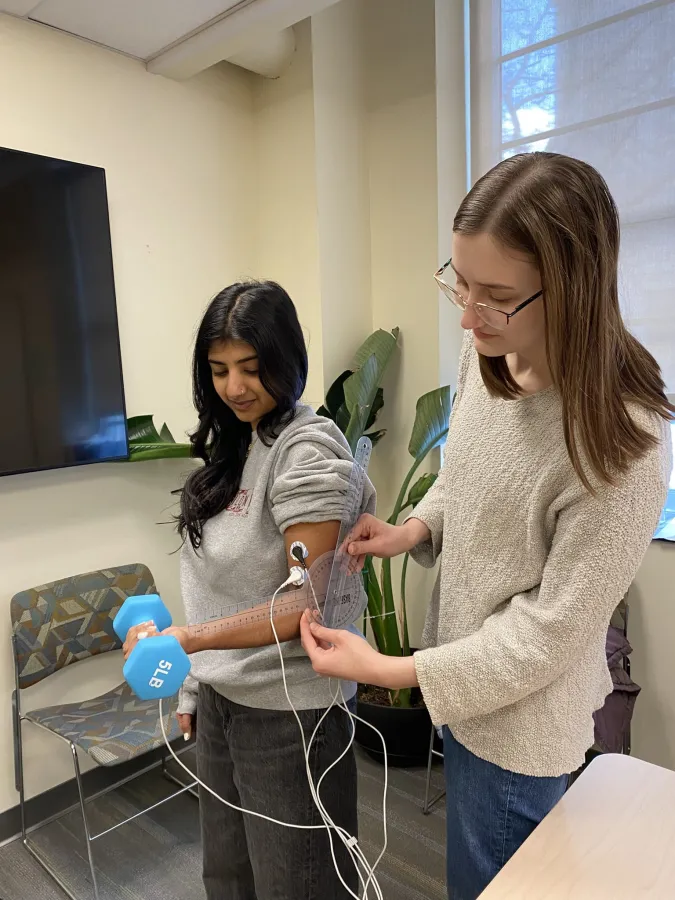
Physiology lab students, Ms. Aditi Wadhwa (L) and Ms. Danielle Hannah (R), conducting their independent project on the effect of different elbow joint angles on biceps/triceps co-activation detected by electromyography. Aditi and Danielle are graduating seniors who will join the school of medicine and dental medicine, respectively, this coming fall.
He explains how all of these new resources can benefit students in a variety of ways - from making complex subjects like physiology more accessible, to helping students develop critical thinking and communication skills in a new way.
During the height of COVID, Burhan knew he would need to leverage digital learning tools in order to accommodate remote learning. He approached ADInstruments and adopted the online learning platform Lt, a tool that he decided to continue utilizing once he returned to in-person learning due to its versatility and success with students.
“Lt was the perfect innovative teaching tool to enhance my physiology lab course. It stood out for its engaging content, flexibility in customizing lessons, and ability to integrate real-world scenarios, which aligns well with my student-centered teaching philosophy.”
Focusing on higher-order thinking and foundational lab skills
Lt continues to serve Burhan as a powerful teaching tool. Combined with Lt Sensors hardware, Lt gives students the opportunity for hands-on, experiential learning to deepen their understanding of core concepts. This is extremely important to Burhan, who knows that students have a tendency to prioritize memorization over in-depth comprehension when faced with a complex subject. Burhan explains that using Lt’s built-in experiments, content, and analysis tools allows him to “coach students to enhance higher-order thinking, foster meaningful group interactions, and connect lab exercises with course material.”
Please Note: PowerLab Sensors are the new education hardware solution from ADInstruments, building on the foundation laid by Lt Sensors. Learn more about PowerLab Sensors »
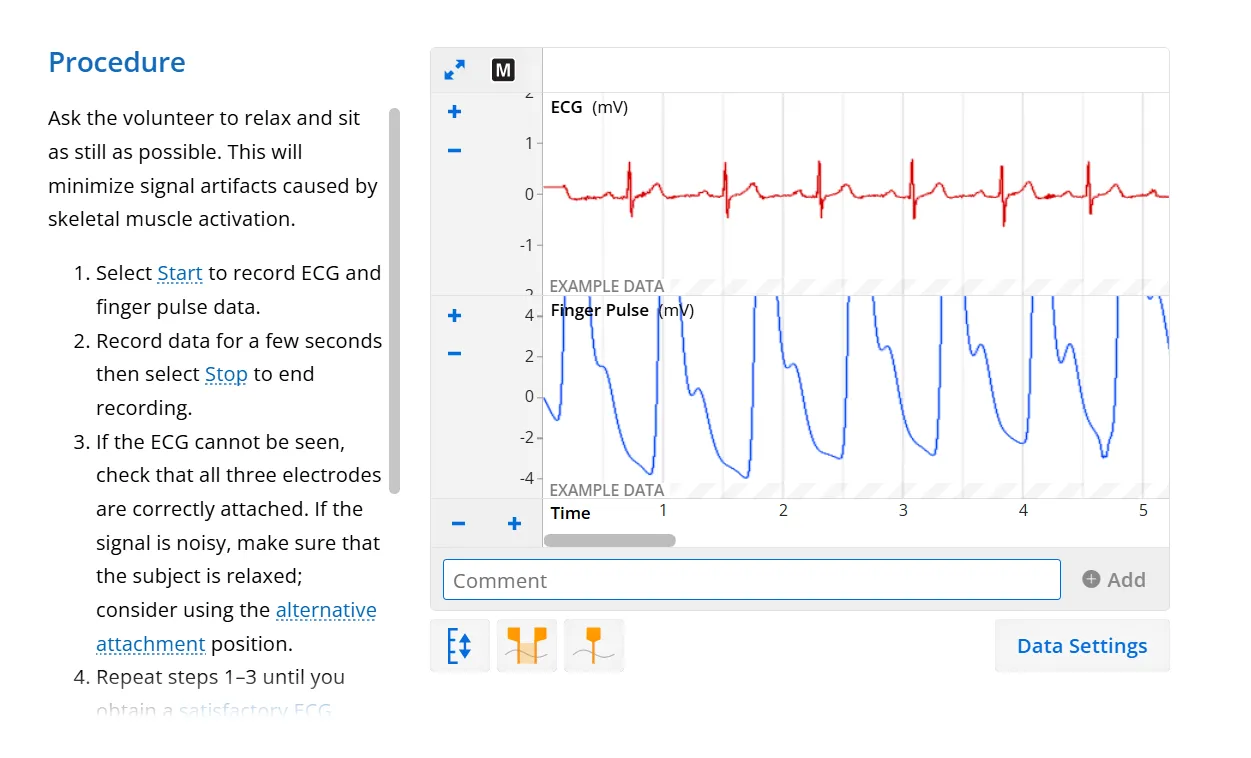
Example data in an online human physiology lab in Lt, "Cardiovascular Effects of Exercise".
The customization aspect of the platform also enables him to support a variety of learning types. “I use various modalities, including animations, graphics, and illustrations, to clarify the science,” he explains. These resources are easily incorporated into lessons via drag and drop.
The platform has pre-lab exercises that students complete prior to coming in, which help them to review important concepts applicable to the upcoming activity. During the lab, students are assessed on their ability to analyze the data they collect along with their completion of various module tasks.
In addition to regular lab exercises, Burhan has also incorporated independent project work for his students to drive home important skills they’ll continue to use in their scientific careers.
“In regular four-month semesters, students in the lab must write a group mini proposal to conduct an independent project with questions, hypotheses, literature search, introduction, experimental design, and data analysis plan. They are given three to four weeks to conduct their independent project using Lt or LabChart and recruit subjects from their class and from outside their class. Upon completion, they make a public oral presentation of their findings.”
The project serves as a cumulation of important skills and helps to assess their ability to apply what they have learned. One of the recent projects that was conducted by a student involved the comparison of results from the dive reflex experiment across volunteers with varied swimming abilities. Data was segregated by gender and level of swimming experience. Among the volunteers recruited for the experiment was Burhan himself!

The Diving Response Lab in Lt
“Everyone had fun, even though ice baths were not enjoyable for a long time! Incidentally, the students recruited me, their professor, as a subject. Sure enough, my data points were different from those of the other points. My dive reflex responses, including heart rate, recovery time after the dive, and changes in peripheral blood pressure, suggested age-related differences between an average student and the professor.”
Related: Teach them a lesson they'll never forget! The Diving Response Lab...
These hands-on experiences and activities leave a lasting impression on the students, some of whom have even left feedback to Burhan noting that “the physiology lab is the best lab they had in their four years!”
In the future, he hopes to accompany this long-term project with a scientific writing module, where students will write a data-driven paper based on their project and results.
Words of Advice
Burhan plans to continue supporting his students by emphasizing active learning with real-world applications. He will follow a student-centered learning approach in order to cultivate his students’ interest in science and ultimately prepare them for long-term careers in the health professions.
He encourages fellow anatomy and physiology educators to leverage the benefits of technology while not overdoing it. “Learning curves can be steep and time-consuming for the instructor,” he warns. “Keep it simple…One cannot use every tool, and there is no perfect modality. Every app has pros and cons. The more you use it, the better you are at detecting pitfalls and closing gaps.”
ADInstruments would like to thank Dr. Burhan Gharaibeh for taking the time to speak with us regarding his experiences and teaching philosophies. We hope to continue supporting him in his mission to foster student growth and curiosity.
Dr. Burhan Gharaibeh, PhD
Dr. Burhan Gharaibeh
Teaching Professor
Department of Biological Sciences
University of Pittsburgh
In addition to his role as a faculty member at the University of Pittsburgh, Dr. Gharaibeh is also an active member of the Human Anatomy and Physiology Society (HAPS) and co-host of the HAPS 2025 annual meeting. He participates professionally as a reviewer of several journals in his field and contributes to community outreach by presenting popular scientific lectures in Pittsburgh.
Dr. Gharaibeh was also the recipient of the Discipline-based Science Education Research Leader Award in the last three years (2021-2024 ) and the Innovation in Education Award in 2023. These awards promote and support evidence-based approaches to teaching and learning in the natural sciences at the University of Pittsburgh.