

As many educators know, the cost of course materials can create additional financial burden for students. According to student-reported data for the 2022 - 2023 academic year, the National Association of College Stores noted that average spending on required course materials was $285.
For some students, these costs can lead to additional stress, hesitation to purchase, or skipping the purchase altogether - all of which can negatively impact overall academic performance. As one frustrated student noted in a 2024 Reddit thread:
"Thousands for tuition just to have to dish out another few hundred on textbook programs, UGHHHH” Reddit, CollegeRant Thread
Dr. Dan McNabney, Assistant Professor (Educator Scholar Track) at the University of Arizona, has made it his mission to reduce this financial burden by creating low-cost course materials for students in his Human Anatomy & Physiology courses. Learn how Dan has successfully combined the power of open educational resources, large language models, and the online learning platform Lt to create a set of customized course materials that best support his students and reduce costs to them by 75%.
Working Backwards

Backward course design prioritizes learning objectives and outcomes
Dan’s starting point was simple: he had to begin with the end in mind. Adopting backward course design principles, he anchored all of his work into learning objectives prior to creating any sort of course material.
Related: The power of backward design in education
This was incredibly important for the University of Arizona, where the Anatomy and Physiology courses serve students from several majors across campus, including one of the universities largest majors - Physiology.
“Every course at every university is going to be a little different, so learning objectives are going to vary a little bit,” Dan explains. “Ours is part of our Physiology major. It’s a large major, the third most popular on campus, which is pretty unusual. We have tons of upper division courses that need to be served by this course, in addition to other majors that rely on it as well. So those learning objectives are really focused for our specific scenario within this design.”
With learning objectives as the foundation, Dan could proceed to the next step: building the text material and activities.
Building On Open Educational Resources
Dan knew there would be several large hurdles to overcome in pursuit of his goal to create a comprehensive set of materials, with the greatest challenge being the course materials themselves. Creating a set of course materials from scratch for both the lab and lecture portions of the course was an overwhelming task.
“The novel creation of course materials is obviously a HUGE undertaking,” Dan notes. “Nobody has the time.”
This is where open educational resources (OER) came into play, providing free, openly-licensed teaching material (such as textbooks, lesson plans, assessments, etc.) that can be accessed and used by anyone. For Dan, OpenStax Anatomy and Physiology, along with his own set of published OER material from a previous project, became the perfect foundation to build from.
Dan and several of his colleagues began by constructing a set of course materials for the A&P labs. Over the course of a summer, they worked to adapt and refine the OER materials to match the specific learning objectives and course content at the University of Arizona, ensuring relevancy and supplementing it as needed.
Members of the Course Materials Creation Teams: Allyson Roof, Joseph Agosttini, Hilary Lease, Aiden McRobbie-Johnson, Dan McNabney, Tim Maley, and Mattie Klass
“The continued development of open educational resources that are available to everybody, and the continued improvement of those resources, has really opened the door for this project. For me, the last push that really made this possible is the ongoing development of artificial intelligence based material. Large language models that can support a more efficient and a high throughput creation of materials, using open educational materials as a foundation for that.”
Dan is able to significantly speed up the process of writing new text material by leveraging large language models to generate initial drafts. He can then refine those drafts as needed, ensuring the material is accurate and at the appropriate level for their undergraduate students.
“As one of my colleagues is fond of saying, you have to have a human brain on both sides of an interaction with a large language model or AI tool. You’ve got to prompt it effectively, but you also have to follow up on the other end too and make sure it’s correct.”
Combining the power of adapted OER material and large language models has been pivotal for Dan and his team members. At this point in time, they have completed an entire set of lab material for A&P l and II, and are only one chapter away from a full set of lecture material.
Modernizing From Paper to Platform Delivery
The next hurdle was finding a way to deliver the course materials. Dan wanted a streamlined approach for delivering these materials, while keeping the overall cost low for students.
The “old-school” way Dan reflects, was to create your collection of materials and have it copied and put into a 3-ring bound book at an office supply store. Students would ultimately purchase this rather than a textbook at the bookstore. While tedious, this was a successful way to focus the set of course materials to specific learning objectives and reduce costs.
“The newer-school version is to do that with an online platform,” Dan explains. A long-time ADInstruments user, Dan previously utilized the Lab Tutor software to do so, and eventually transitioned to the cloud-based learning platform, Lt, when it became available.
“Even within Lab Tutor I really appreciated that I could customize my course materials, there were no lab manuals. Students had full access to everything whenever they needed it. Transitioning to Lt made it even better. Now you are working in a cloud-based system, it’s device agnostic.”
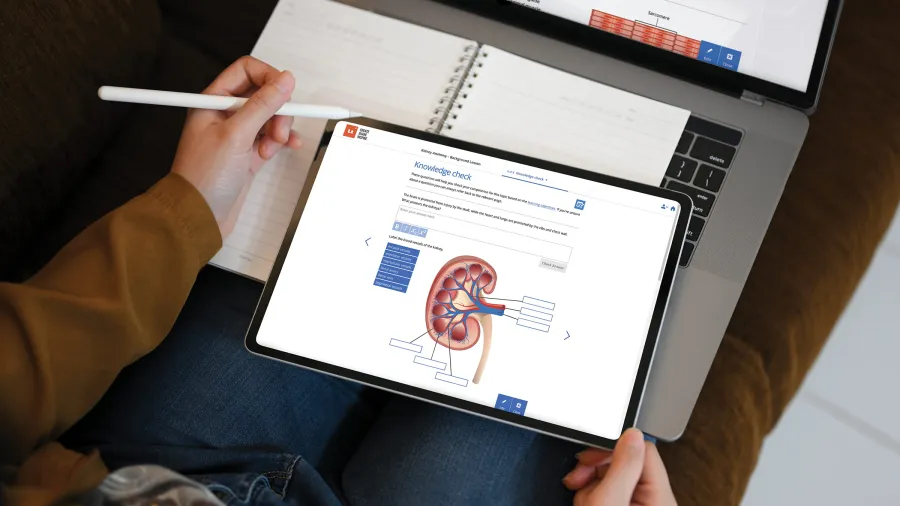
Lt’s cloud-based technology lets students prepare for class and revise their course material anytime, anywhere.
Students in the A&P course sequence utilize Lt for its pre-lab and post-lab modules, helping them to prepare for the lab period itself and then building on what they learned afterwards. Lt provides a variety of benefits for Dan as a host platform, including:
- Ready-to-use content that is fully customizable
- Easy to use editing features to create your own modernized lessons
- Engaging question types and active-learning formats
- 24/7 access to all course material, whether students are in lab or at home
- Low student cost
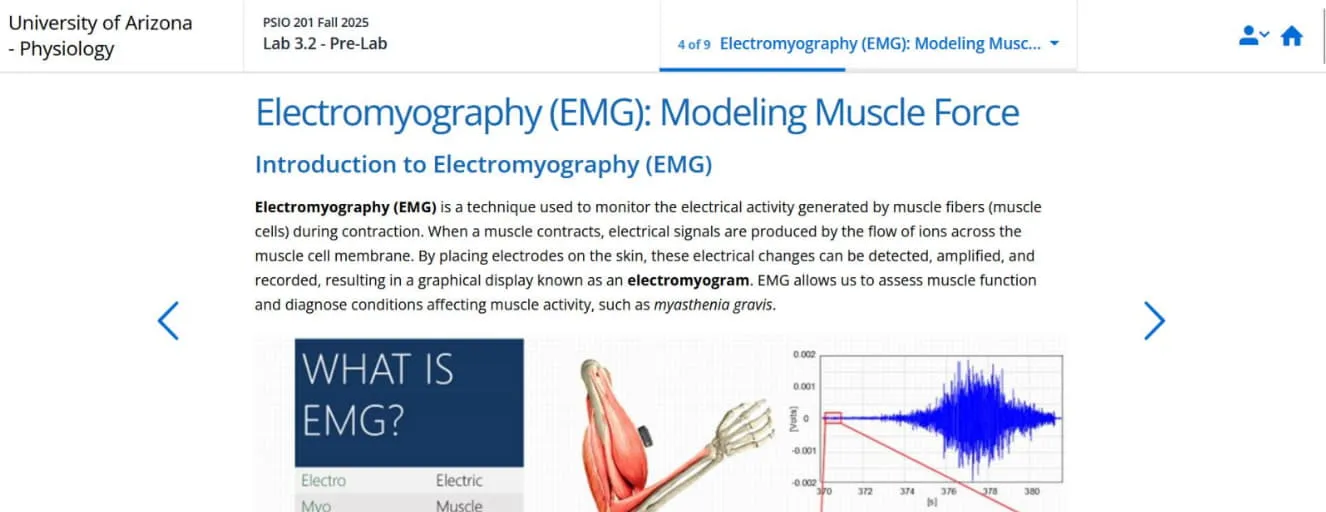
Lab course material example within Lt platform. Image courtesy of Dan McNabney.
For less than $35 per student per semester, Dan can streamline the way his course materials are delivered to students while keeping the financial burden on them quite low. Paired with the Pay One Price model offered by the University of Arizona (which institutes a cap on the cost of course materials per semester), students are less weighed down by course material costs and able to plan better financially.
Related: Lt Pricing Calculator - Select a package to suit your teaching and students' needs
“It offers a $250 cap for what it will cost students for their course materials,” Dan explains when describing the model. “Students can opt in or opt out - they choose. So it may be that if they are taking Biochemistry, A&P, and Physics all at the same time they will easily surpass that mark. But if they are taking three Gen Eds and just A&P, they may not surpass it. In that case, they can opt out and just pay the a la carte option.”
Dan also personally appreciates how the platform helps to streamline the material and eliminate confusion around what students “need to know”.
“The thing I love the most is when students ask me ‘What do I need to know?’, the answer is just ‘Yes’. If you see it, you need to know it. As opposed to traditional publisher textbooks…I used to have a document that was called the “Need to Know.” And it would include the specific sections of the textbook that they would actually need to read and look through. So just to be able to eliminate that and say look, if it’s there you need to know it, is way more simplified. For students and instructors.”
Reducing Costs and Supporting Student Outcomes
Pairing the cost of Lt per student with the university’s Pay One Price model has resulted in a significant decrease in total cost for course materials for A&P students.
“So what used to be a lecture textbook, a lab manual, an atlas, a dissection guide - all the things when I was a student that you’d have to buy separately that would total about $250 just for that one course. For our students, this has turned into a 75% reduction in course material costs.”
Students have responded well to the use of the online platform, with results from the lab course feedback survey indicating that the Lt pre-lab and post-lab lessons were largely helpful.
The graph below shows how students rated the helpfulness of various lab resources.

Lab course materials feedback survey results for PSIO 201. Image courtesy of Dan McNabney.
“Feedback from students was very positive,” Dan adds. “The students that used the Lt pre-lab and post-lab lessons found them super helpful.”
Continuing the Work
While the creation and implementation of low-cost, inclusive material has been largely successful so far, Dan will continue to refine and build on this initial work.
In addition to refining learning objectives and adjusting course material as needed, he hopes to integrate existing and novel AV material (videos, podcasts, etc.) in the future.
Dan also aims to further increase the inclusivity of the course material and better support students going into the health professions by translating the material into Spanish and other languages down the road.
“As a Hispanic-Serving Institution, one thing that we are strongly interested in is an authentic translation. That is in the plans for the future, to provide complementary materials both in English and in Spanish to support and serve all of our students.”
Dan presented his work at the Physiology Majors Interest Group (PMIG) 2025 Annual Meeting. You can view a copy of his presentation here.
ADInstrument would like to thank Dan for taking the time to connect with us about the important work he is doing in making course materials more accessible and affordable. We look forward to continuing to support Dan and other educators alike.

Dan presenting at PMIG 2025.

Dan McNabney, PhD
Dan McNabney, PhD
Assistant Professor (Educator Scholar Track)
The University of Arizona
Dan's research interests include the creation, implementation, and evaluation of inclusive and effective anatomy and physiology learning materials to support student learning.
Credits and Acknowledgements:
Daniel R. McNabney, Allyson K. Roof, Hilary M. Lease, Joseph A. Agosttini, Aiden McRobbie-Johnson, Tim Maley, Mattie Klass, Claudia I. Stanescu
Department of Physiology, College of Medicine – Tucson, University of Arizona