

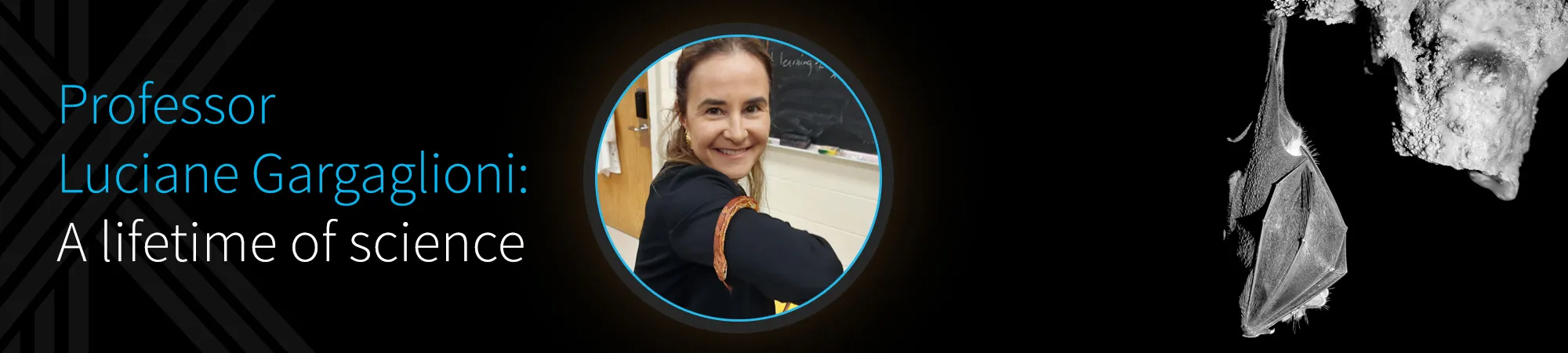

Professor Luciane Gargaglioni always wanted to be a biologist. What began as a childhood passion for animals has evolved into a solid career in science, with important discoveries in comparative physiology, neuroscience, and respiratory control.
During her undergraduate studies in Biological Sciences at USP in Ribeirão Preto, Luciane immersed herself in the world of vertebrate zoology. While still in her second year, she was already doing field work and completed her monograph studying bats in the Luís Antônio Forest Reserve, the largest cerrado reserve in the state of São Paulo.
After a brief stint as a high school teacher, Luciane decided to pursue scientific research. During her master's degree, she began to study the defensive behavior of amphibians - more specifically tonic immobility (or thanatosis), a strategy of playing dead in the face of predators.
Her curiosity for physiology led her to a PhD focusing on
"I always wanted to be a biologist ever since I was little [...] I was always sure of what I wanted."
the respiratory system of amphibians, particularly the phenomenon of episodic breathing - quite different from the continuous breathing of mammals. A sandwich doctorate at the University of British Columbia in Canada broadened her experiences and consolidated her work in neurophysiology.
Comparative research
Following her work on amphibians Luciane branched out, exploring thermoregulation and respiration in rodents.
"I started doing post-doctoral work on serotonin neurotransmission, the involvement of serotonergic neurotransmission in thermoregulatory and respiratory responses in rodents."
On taking up her post as a lecturer at São Paulo State University (UNESP) in Jaboticabal, Luciane founded her own laboratory and quickly attracted funding from Fapesp as a Young Researcher. With the support of her team, she made groundbreaking discoveries, such as the importance of the locus coeruleus in the response to CO₂ in amphibians and mammals.
"Our group was the first in the world to show that this region is important for the response to CO₂ in amphibians. We were also the first to demonstrate that this region is important for the ventilatory response to CO₂ in rats"

As her research developed, Luciane began examining the interaction between the sleep-wake cycle and breathing patterns of transgenic animals, and moved from rat models to mice.
"The challenge arose because for a mouse, to put the electrodes in and put the animal in the box was very heavy and we were looking for alternatives."
The search for better experimental data led Luciane's group to adopt the Kaha Telemetry system for electrophysiological monitoring in mice. The technology solved a common challenge: the inconvenience and limitations of the wires on the animals.
"That's when we came across the Kaha system from ADInstruments, which would be an interesting alternative for us because it's a wireless system and the animal can move freely in the chamber.
So, as we're interested in respiration, the sleep-wake cycle and evaluating the animal's behavior, if the animal has a lot of wires it gets in the way. So we started implementing this system here in the lab."
Diversity of Models and Approaches
Currently, in addition to rodents, the group also studies diving birds, cave fish and neonates, always focusing on physiological and respiratory adaptations in environmental and evolutionary contexts. The broad approach combines an interest in comparative physiology and translational research.
A recent partnership with researchers from UFRJ compared the effect of anti-inflammatory drugs on humans and mice, revealing that the drug was as effective as traditional anxiolytics.
"It was a very interesting partnership between the clinical and pre-clinical sides."
Looking to the future

With her thematic project drawing to a close, Luciane is already thinking about the next steps: studying the effects of inflammation and maternal care on the respiratory development of offspring. New ideas and collaborations are being planned.
Although she now works with other models, Luciane has never forgotten her interest in bats, especially their torpor behavior. Perhaps this group will once again be the focus of her research?
"I still have a lot of questions about them. I think I'll come back one day."