

By: Alicia Marin
Around one-third of people with epilepsy don’t respond to traditional medication, and some of these drug-refractory cases often have seizures that are subtle, unpredictable, or completely invisible without EEG. To develop new treatments, such as gene therapy or chemogenetics, researchers need to observe every event, not just the ones that appear on video.
That’s where Kaha Telemetry fits in. Long-term, continuous EEG in freely moving animals enables the tracking of real seizure patterns, the detection of silent events, and the measurement of whether an intervention is actually effective. In short, the burden of refractory epilepsy is exactly why tools like Kaha are essential.
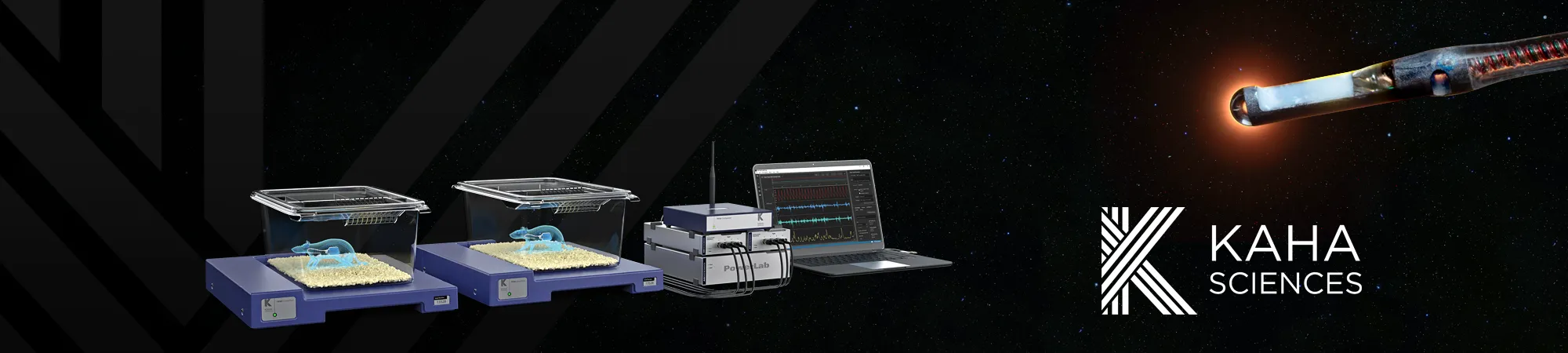
Kaha telemetry system
When it comes to advancing our understanding of epilepsy, few areas hold as much promise as gene therapy. At Lund University in Sweden, Dr. Marco Ledri and his team are developing innovative approaches to treat epilepsy at its source.
Originally from Italy, Dr. Ledri has spent much of his career studying the mechanisms that lead to seizures. After completing his PhD in Sweden and a postdoctoral position in Hungary, he returned to Lund in 2016 to establish his own lab. His work today focuses on using gene therapy to better understand and ultimately prevent epileptogenesis.
Exploring the Future of Epilepsy Treatment
For Dr. Ledri, gene therapy represents not just a new avenue for epilepsy, but an exciting era in medical research more broadly.
“Gene therapy is the future, not only for epilepsy treatment. It is becoming the future for many conditions,” he explains. “It allows us to correct gene mutations or even introduce new ones with therapeutic purposes.”
While the cost of developing gene therapies remains high, he points out that a one-time treatment could ultimately prove more cost-effective than a lifetime of medication - a shift in perspective that is driving increasing attention to these methods. Particularly, considering these viable options for patients with refractory epilepsy.
A Chemogenetic Approach to Controlling Seizure
In a recent publication, Dr. Ledri’s lab explored a chemogenetic approach to modulate neural activity. Chemogenetics involves the use of engineered receptors that respond only to specific synthetic compounds, allowing researchers to precisely activate or inhibit neurons.
“The receptors are engineered in a way that they no longer respond to their natural ligand,” says Ledri. “In this case, they react to a very low concentration of synthetic compound, one that is already approved for clinical use.”
In his experiments, applying this chemogenetic strategy successfully reduced epileptiform activity in brain slice cultures, an important proof of concept for using this specific approach to modulate brain activity and control seizures selectively.
Monitoring Seizures in Real Time - the Role of Kaha Telemetry
Promising therapies are only half the story. The real challenge is proving they change seizure activity in the real world, not just in theory. That’s where long-term EEG becomes essential, a method which Dr Ledri’s lab relies heavily on.

“I would say it is fundamental when doing in vivo epilepsy research,” he notes. “You cannot always detect seizures just by observing the animal. Many events have no visible behavioural signs, and only EEG can capture those.”
Illustrative EEG seizure data recorded via Kaha Biopotential Telemeter; not study-specific.
Kaha Telemetry allows his team to record continuously for weeks at a time, which is essential for studying seizure clustering, which are periods when seizure frequency fluctuates unpredictably.
“We typically record for at least three weeks, and sometimes up to nine. With Kaha telemetry, we are not limited by battery life like we were with other systems, and that makes a huge difference,” he adds.
Balancing Innovation and Responsibility
Working in animal models is still indispensable for translational epilepsy research, particularly for understanding how network-level brain activity changes. However, Dr. Ledri and his team are also exploring organoid and in vitro approaches as complementary tools to refine their models and reduce animal use whenever possible.

“Epilepsy is a network disorder that often involves the whole brain,” he says. “We try to minimize animal use as much as we can, but at the end of the day, there is no substitute for studying the entire brain.”
EEG Top Head
Long-term EEG recordings using Kaha Telemetry also support ethical research practices by reducing the number of animals used.
“We can record from the same animal before and after treatment,” he explains. “That already cuts animal use in half.”
Advice for Researchers Starting with Telemetry
For those considering introducing telemetry into their own work, Dr. Ledri emphasizes that telemetry can easily be integrated into existing research lines, provided that the lab has the necessary surgical expertise. For researchers working in translational epilepsy, he considers long-term EEG recordings to be essential.
“If you are working on translational epilepsy research, you definitely need to do some sort of EEG recordings. And Kaha telemetry gives you the freedom that the animals are in their own cages, living normal lives,” he explains. “It is a big improvement compared to the old days when animals had to be tethered, which restricted their movement and limited how much data you could record.”
His conclusion is simple and clear:
“If you are thinking about doing long-term EEG, Kaha Telemetry is the way to go.”
Where the Field Is Headed
Looking ahead, Dr. Ledri believes there is a need for alternative ways of tackling epilepsy to avoid resistance to traditional pharmacological approaches, which affect 30%-40% of all people suffering from epilepsy. In his opinion, the most promising advances will come from targeted, localized treatments
“Gene therapy will not solve all forms of epilepsy, but for focal cases, where you can pinpoint the region of the brain involved in seizure generation, it could be transformative,” he says.
He also highlights the emerging potential of stem cell therapies, noting that early clinical trials are already underway using inhibitory neuron transplantation to restore balance in hyperactive brain circuits.
Continuing the Search for Better Solutions
In his own lab, Dr. Ledri continues to explore neuropeptides and neurotrophic factors as potential therapeutic tools. His long-term vision is to combine these insights with gene-based delivery systems to develop treatments that could one day make a tangible difference for patients living with epilepsy.
Despite the challenges of working in such a demanding field, he remains optimistic.
“Research is a struggle,” he admits. “Ninety percent of the time, it does not work. But it is the ten percent that drives you forward. If you stay motivated and keep that long-term vision, the rest will follow.”

Dr. Marco Ledri
Dr. Marco Ledri
Head of Epilepsy Center,
Lund University, Sweden
Dr. Marco Ledri leads a research group at Lund University, Sweden, focused on developing novel gene and cell-based therapies for epilepsy. His lab integrates neurophysiology, molecular biology, and in vivo studies using Kaha telemetry to uncover mechanisms of epilepsy and epileptogenesis and test innovative treatments