
Beyond the Dashboard: Why Specialised Science Platforms Outperform Generalist LMS in the Laboratory
In the world of EdTech, it is easy to assume that any platform delivering a digital lesson is a Learning Management System (LMS). While platforms like Canvas, Moodle, and Blackboard are essential for institutional administration, serving as the digital registrar, the grade book, and the central repository for lecture notes, they weren't built to handle the unique, data-driven demands of a physiology or biology lab.
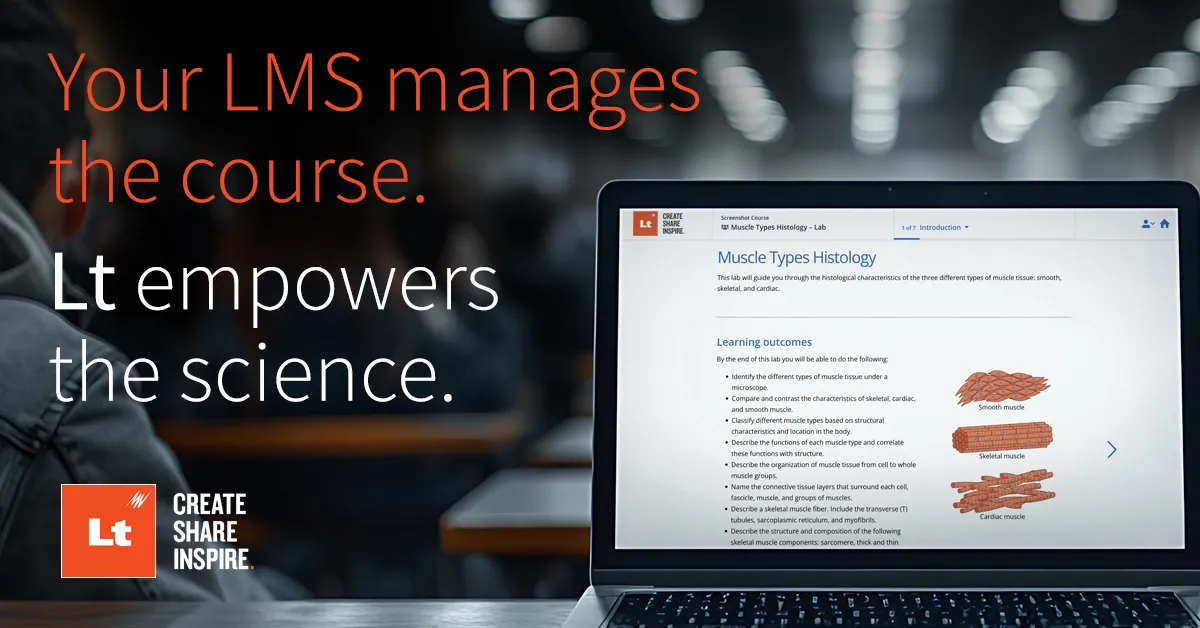
If you are wondering why you would need Lt when you already have an LMS, it comes down to one distinction: The LMS manages your course, but Lt empowers the science.
For science educators, this missing this distinction can lead to a "tool-gap" in the laboratory. While an LMS is designed for the administration of learning, Lt by ADInstruments is designed for the acquisition of knowledge.
The Pedagogy of Practice
Science is not a passive subject; it is a proprietary blend of theory and tactile evidence. Generalist LMS platforms are built on a "Read-Reflect-Respond" architecture. They excel at hosting videos and text-based quizzes. However, they lack the "active" component required for experimental science.

Lt bridges this gap by providing an immersive environment where students do not simply read about physiological phenomena, they generate the data themselves. By integrating real-time data acquisition with pedagogical instruction, Lt transforms the screen from a static page into a live, scientific instrument.
Precision vs Generalisation
The technical requirements of a life science lab, such as high-fidelity sampling rates, physiological signal analysis, and histology image manipulation, are beyond the scope of a standard LMS. When educators attempt to force laboratory workflows into an LMS, they often encounter "software fragmentation", where students must jump between several different applications to complete a single experiment.

Lt eliminates this friction. By housing the content, the hardware interface, and the analysis tools in a single cloud-based location, the cognitive load is shifted away from "navigating the software" and back towards "understanding the science".
Proof in Practice: The University of Aberdeen
The value of Lt isn’t just in its standalone power, but in how it harmonises with existing institutional systems to reduce administrative friction while elevating the student experience. Prof John Barrow, Dean for Employability & Entrepreneurship at the University of Aberdeen, highlights how this works in a high-capacity environment:
“We have successfully used Lt across multiple large‑cohort modules (we call courses in Aberdeen), such as our first-year course in cell biology (SM1501, The Cell) with 350-400 students per year. We fully integrate Lt within our Blackboard virtual learning environment (VLE), called MyAberdeen. Our Lt lessons are often used with Lt‑compatible hardware and sensors, but we also use Lt beyond traditional laboratory classes, supporting a wide range of teaching and assessment activities."

"A key advantage of the Lt-VLE integration is that student accounts and grading of assessments are automatically synchronised with the push of a button, removing the need for manual account creation and significantly reducing administrative burdens on staff."
— John Barrow Professor of Biochemistry and Molecular Biology.
Learn how Lt integrates with:
Canvas, Blackboard, and Moodle to automate your grading and student syncing.
Bridging the Gap
For science educators, the choice isn't necessarily between an LMS and Lt—it is about choosing the right tool for the right job. While the LMS (often referred to as a VLE in the UK) serves as your institutional foundation, Lt acts as your digital laboratory. By integrating the two, institutions can maintain administrative oversight while finally giving students the specialised, high-fidelity tools they need to master the complexities of the life sciences.
The Core Difference:
- Your LMS is the Campus Administrative Spine.
- Lt is the Laboratory Nervous System.
- Data Integration
- The LMS: Is a "closed box." It cannot talk to hardware. Students must record data elsewhere and upload files manually.
- Lt: Features Native Hardware Integration. Connects directly to PowerLab and sensors. Data flows live onto the screen for instant analysis.
- Content Readiness
- The LMS: A ground-up commitment. Faculty must build every page, quiz, and module from scratch.
- Lt: Comes with 500+ Peer-Reviewed Lessons. Professionally designed, media-rich content for Physiology, Nursing, and Medicine—ready to use or fully editable.
- Student Experience
- The LMS: Fragmented. Students switch between a browser, Excel, and analysis software.
- Lt: Unified. Data collection, analysis, and assessment happen in one window. This "Single Pane of Glass" approach increases student engagement and completion rates.
- Scientific Visuals
- The LMS: Basic image support.
- Lt: High-resolution Histology and Medical Imaging widgets. Includes specialized tools for data manipulation that mimic professional research environments.
We aren't replacing your LMS—we are upgrading your lab.
- Single Sign-On (SSO): Students enter Lt through your LMS.
- Grade Integration: Lt automatically pushes grades back to the LMS grade book.
- LTI Advantage: Seamless, secure integration with Canvas, Moodle, and Blackboard.
Is your lab outgrowing your LMS?
- Let’s discuss how to bridge the gap in your specific curriculum.
- Book a personalised demo with a specialist here