

Written by: Stephanie Peragine | Scientific Education Specialist
Natasha Hadgraft is the Programme Leader of MSc Human Physiology and MSc Neuroscience at Manchester Metropolitan University (MMU). As a Cardiovascular Science lecturer, she also teaches on undergraduate programmes including Biomedical and Healthcare Science. She is pioneering scientific education by developing spaces that enable students to learn technical and practical skills, not only in the laboratory, but across tutorials, seminars, and wider learning environments. By combining the power of the long-time trusted PowerLab and novel USB Sensors, MMU has created unique learning studios where students can develop their skills, giving them a solid foundation for a variety of career paths.
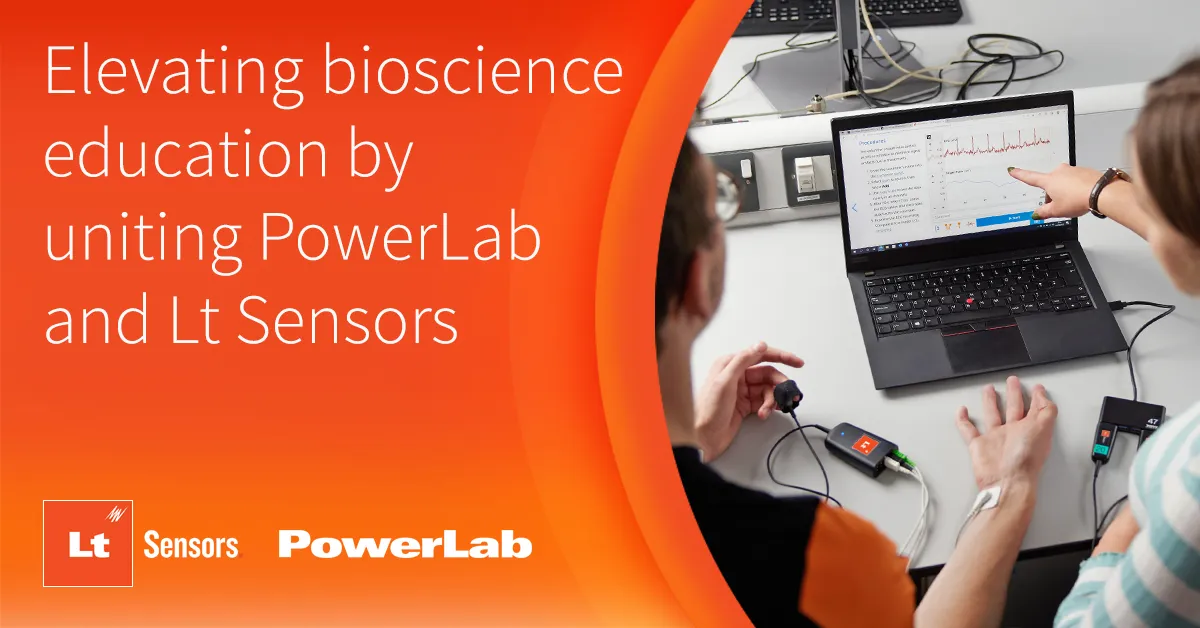
MMU has embedded Lt, a hybrid learning platform for delivering scientific and clinical lessons and practicals, into these spaces. Because Lt integrates directly with data acquisition hardware, students can capture physiological signals in real time and apply those insights to interactive lessons and patient cases. The result is a complete ecosystem that bridges the gap between theory and hands-on technical skills.

Lt sensors sampling in Lt
Please Note: PowerLab Sensors are the new education hardware solution from ADInstruments, building on the foundation laid by Lt Sensors. Learn more about PowerLab Sensors »
Students gain data acquisition skills, even outside the laboratory
The Life Sciences department had consistently used PowerLabs to run their laboratory practicals over the years. More recently, the University opened a new science building complete with studios designed for active learning. Here, they introduced ADInstruments’ portable USB sensors. This allowed the department to teach the same physiology practicals, but with the flexibility to record and analyse data in tutorials held in the active learning studios. This meant they could showcase an ECG or have students learn a technical skill without being dependent on the availability of a laboratory. They often pair the USB sensors with Lt’s prebuilt case studies to further facilitate discussions and apply their knowledge.
“We can see them do their skills and essentially tick them off. They can showcase that they can do [...] spirometry and interpret, then analyse that data. So it's showcasing some understanding and being able to apply that knowledge.”
“It's allowed them to develop skills that they wouldn't have necessarily had the option to do until later on in the programme.”

Prepare students with the relevant skills, no matter what career path they choose
MMU students have a wide variety of career ambitions, including clinical and scientific aspirations. Using the dynamic combination of Lt software and integrating PowerLab and USB sensor hardware, they can deliver theoretical and patient-centred content alongside hands-on practical training. This comprehensive setup equips students with a foundation of skills they need to solve the real-world problems they’ll face in their career pathways.
“We can tell them about the anatomy of the heart, we can tell them what happens in heart failure, but having some sort of case study where they can look at a patient with that [heart failure] and piece those different things together, that helps their understanding and that helps set them up if they are wanhttps://www.adinstruments.com/lt/features?lang=enting to go down that clinical route.”
“At the same time, many are interested in other career avenues like research. With Lt, they're taking physiological measurements, interpreting and analysing data, and as such, it can also be used for project work involving participant-focused research. They're looking at taking measurements from participants. That's a really important skill to do, and then also interpreting that data. If they're then interested in going on to apply to a scientist training programme or medicine, they've got that kind of skill under their belt. They've been able to work with participants, which is an important skill for that career.”
Please Note: PowerLab Sensors are the new education hardware solution from ADInstruments, building on the foundation laid by Lt Sensors. Learn more about PowerLab Sensors »
Increase active learning opportunities, engagement, and attendance
Natasha has seen an increase in engagement as a result of integrating USB sensors to do real-time data collection in their tutorials. She and her colleagues have successfully created more interactive and exciting learning opportunities, which means students are more likely to attend on-campus sessions

Lt sensors used by students
“Allowing them to engage with material a lot more and in an exciting way than me just saying, this is an ECG, this is how it works, this is electrical activity through the heart. Our active learning-based teaching is designed to engage them. We can still do those things in the lab, but it allows them to be integrated into other activities.”
“If they know we're having a tutorial, I think if it's an enjoyable tutorial, the more likely they are to attend it. And then the more likely attend subsequent ones, because they can see the worth for these activities and sessions”
On sensors: "It has a positive effect on engagement"
Reducing lab repetitions
MMU’s impressive superlab hosts the laboratory practicals for several courses. Due to the size of the Biomedical programme, the laboratory and its PowerLabs could be in use for several days. The ability to run practical-based tutorials with USB sensors in parallel to the main laboratory meant that lab repeats were reduced and timetabling constraints were minimized. By utilising both hardware systems, the department was able to scale their teaching without compromising on data-quality. They also found that students interact with data in the same way, regardless of whether they use PowerLab or USB sensors.
“[We had] a lot less [PowerLabs] than we did the sensors and we wanted to essentially cater for a larger cohort. Our programmes are only getting bigger, particularly biomedical sciences. It's a very popular one, and we wanted to be able to have enough resources to hold those practicals without having to repeat the practical again and again. The sensors allowed us to do that, but also the fact that they were far more portable, allowed them to essentially be used in tutorials and seminars as well, and I think that's really what ties into that active learning”
“I don't think their response is different between PowerLabs and Sensors. But I do think they find both very engaging and the PowerLabs are likely more what students would expect to see in research or clinical labs.”
Natasha Hadgraft
Programme Leader of MSc Human Physiology and MSc Neuroscience at Manchester Metropolitan University (MMU)
I joined Manchester Metropolitan University in 2019 as a Tutor in Physiology, shortly after completing my PhD on the effects of proinflammatory cytokines on cardiac muscle cells. Since then, I have advanced into a lectureship and have taken on a range of leadership responsibilities. My teaching has spanned most of our life sciences programmes, with a particular focus on Human Physiology. Although I continue to value research‑led teaching and remain engaged with developments in my field, I found myself increasingly drawn to the educational side of my work. As a result, I recently transitioned into a role centred on Education, Practice and Citizenship. In this position, I play a key part in promoting the use of digital technologies in teaching across my department, and I have developed a strong interest in the use of simulation as a tool for enhancing student learning and supporting skill development.