


One of the greatest challenges educators are confronted with today is engaging their students beyond passive instruction. Our team of education specialists interact with educators across the globe every day, and recognize the feelings of frustration that many are experiencing when it comes to students superficially absorbing information. By not actively interacting with the material, both students and educators suffer in the long run, as passive instruction often leads to lower retention and engagement rates.
The importance of active learning when it comes to student outcomes and long-term success is widely recognized, but the challenge remains of how to encourage students to take ownership of their learning.
Our Lt Mini Labs are designed to foster independent learning by providing a structured, yet flexible approach.
Let’s dive into the Hyperventilation and Rebreathing Mini Lab to learn more about how these labs are designed to engage students.
The Hyperventilation and Rebreathing Mini Lab provides a streamlined approach to independent data collection and analysis. Students are guided from start to finish - with clear instructions and protocol. The natural, intuitive flow of the lab ensures that student focus is on learning rather than worrying about properly connecting equipment or troubleshooting. Rather than relying on constant help from their instructor, they can progress through the material at their own pace.
Our Education Applications Specialist, Sophie Duong, notes how important this approach is for enabling active learning:
“The lab provides clear guidance and promotes active engagement by requiring students to interact with the material at each stage.…Although the lab is structured, it still requires students to make decisions, reflect on their findings, and understand the process, which fosters a sense of ownership over their learning within the framework provided.”
During this lab, students use the Spirometer Sensor to explore how respiratory rate and expired volume of gas change in response to hyperventilation and rebreathing expired air. While performing the lab activities, students are able to instantly visualize their data on the value panel.
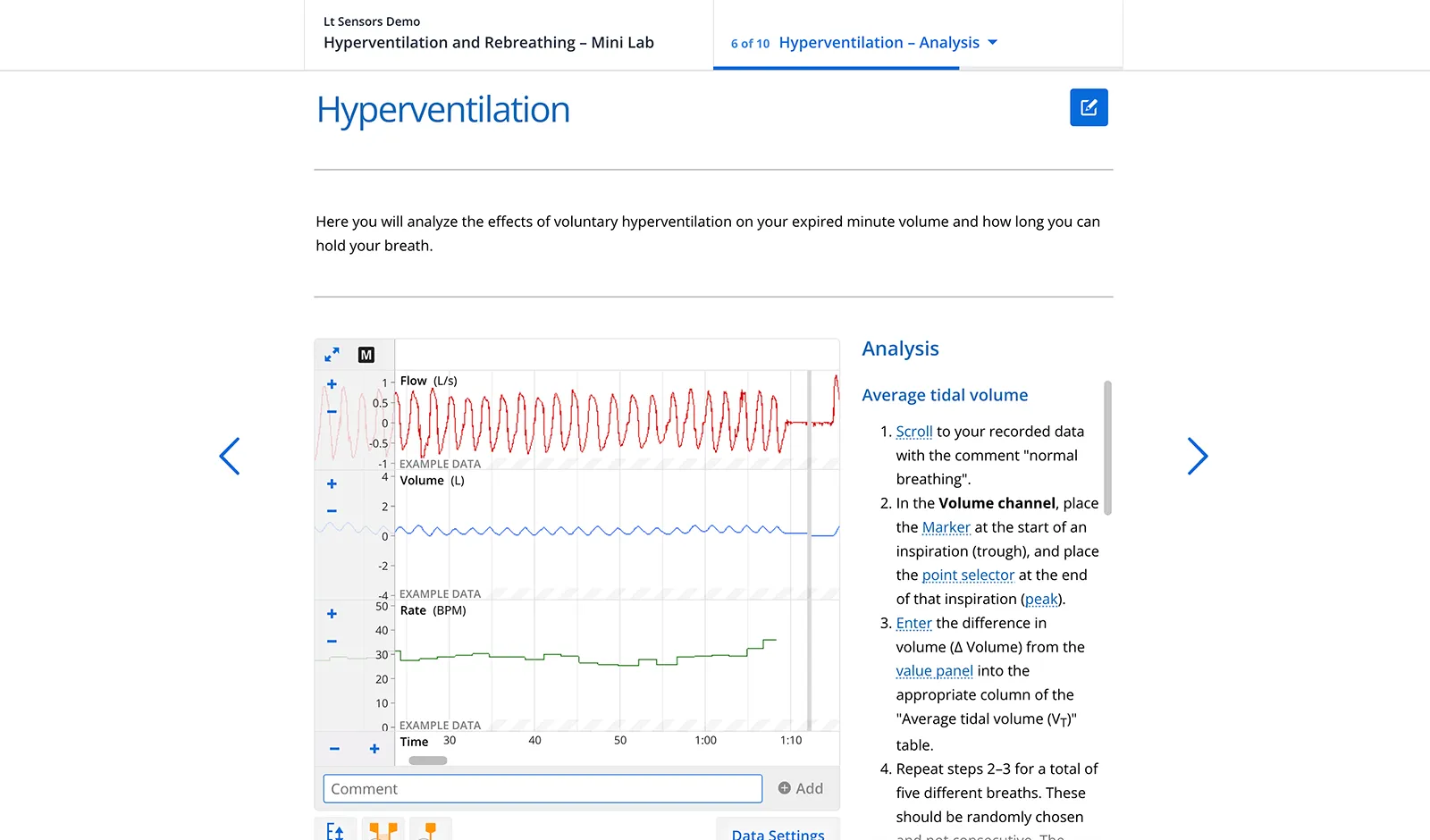
Value panel with example data from the Hyperventilation and Rebreathing Mini Lab in Lt
Lt’s user-friendly tools allow them to mark, select, and highlight different segments of data. The lab's protocol guides them through the process of inputting their values into a table, which automatically populates into a graph. These built-in tools encourage a guided-form of exploration. Students can interact with their data and instantly visualize the results for immediate insight into the physiological effects that they are studying. This instant feedback loop encourages critical thinking, as students can hypothesize, test, and develop their understanding based on what they see.
Making the data accessible and easy to understand is critical for fostering curiosity. Students are active participants in their own learning, asking questions and seeking out answers through experimentation. As Sophie notes, this experimentation is extremely important for students in order to make the connections that they need to:
“The tools that are built-in to this lab allow students to experiment with different scenarios, analyze data, and interpret results - fostering deeper exploration and reinforcing critical thinking. This hands-on interaction keeps students engaged, supports inquiry-based learning, and allows them to make meaningful connections between theory and practice.”
As they progress through the activities, students will be prompted to check their understanding through a variety of question types (sorting, multiple choice, free response, etc.). These check-in questions provide immediate feedback, giving students time to reflect and discuss with their lab group. If a response was incorrect, they can navigate backward in the lab to review earlier information.
In this short clip from our virtual demonstration of the lab, our North American Education Applications Specialists discuss the impact of these knowledge checks.
The Hyperventilation and Rebreathing Mini Lab empowers students to take charge of their own learning through a structured, hands-on approach to respiratory physiology. This self-directed learning experience gives them the chance to engage at their own pace and receive immediate feedback into the physiological effects of hyperventilation and rebreathing. The powerful tools built into Lt allow students to independently collect, analyze, and interpret their data.
By shifting the focus from passive instruction to active learning and engagement, our Mini Labs support students on their journey to becoming independent thinkers and developing the critical thinking skills they will need for future academic and professional success.