

In this webinar, presenters Dr. JC Han and Esau Mhandu explore various methods for applying load to the isolated working-heart. Discover how they use Millar catheters to record left-ventricular pressure-volume during a working-heart experiment and how pressure-volume loops and aortic pressure waveforms can be used to assess cardiac performance and efficiency.
Key Highlights:
- Uncover the connection between tissue-level and whole-heart energetics
- Learn why measuring both aortic pressure and left-ventricular pressure-volume loops are crucial in assessing heart function
- Discover tips and tricks for inserting Millar Pressure-Volume catheters into the left ventricle
- Explore how a new software model precisely controls the loading of an isolated heart
Abstract:
The heart is an energy-transfer system. It converts energy expended to work productivity. Efficiency is a performance measure that links mechanics (i.e., cardiac output, mechanical work) to energetics (i.e., energy expenditure). It measures the ability and competence of the heart as an energy-transfer organ.
At the Auckland Bioengineering Institute, our team has constructed an experimental device (work-loop calorimeter) that enables measurement of cardiac efficiency at the tissue (trabecula) level. In the device, an isolated trabecula is stimulated to perform force-length work-loops under a range of loading conditions. Our findings reveal that efficiency exhibits complex dependencies on preload and afterload.
Building on these findings, we are now investigating whether these load-dependent characteristics of efficiency observed at the tissue level also apply to the whole heart, using a combination of a working-heart system, Millar pressure-volume catheters, oxygen probes and our new software-simulated, hardware-implemented, control system.
Related Products:
Millar Rat Pressure-Volume Catheters
Millar Pressure Catheters
Isolated Working Heart Systems
Isolated Heart Pressure Kits
Mikro-Tip BP Foundation System
Additional Resources:
Guide: Selecting the right research catheter
Priming and Operating your Radnoti Working Heart System
Ventricular Pressure Volume + PV Loops
Guest Speakers:
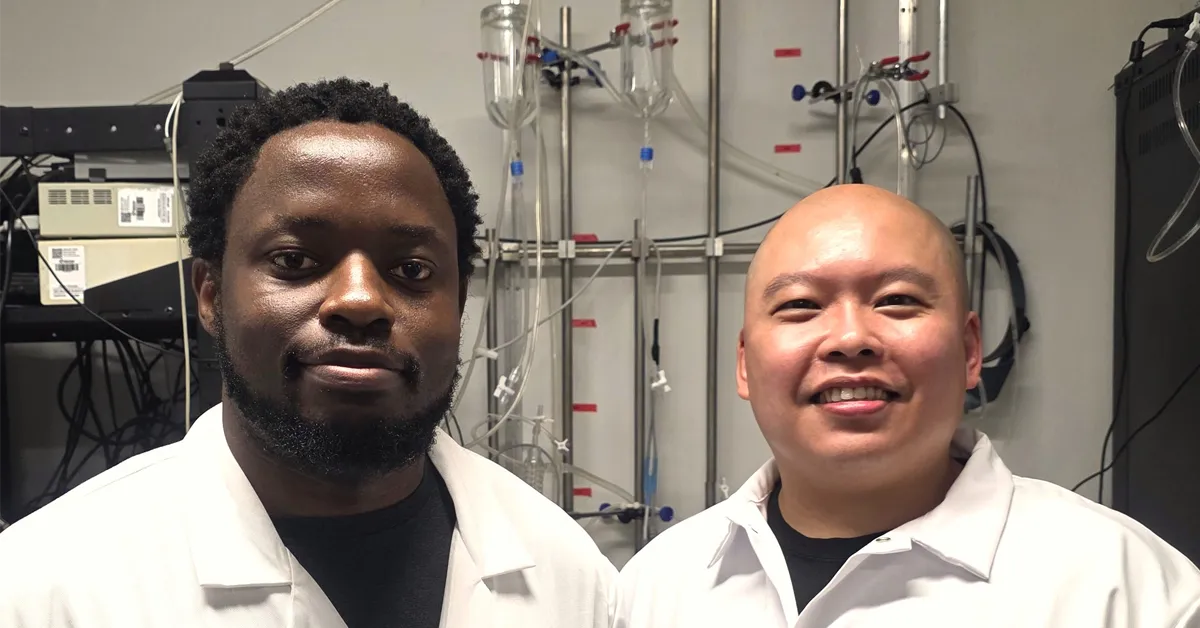
Above: Esau Mhandu (left) and Dr. June-Chiew Han (right) in their lab.
Dr. June-Chiew Han
Senior Research Fellow, Experimental Cardiac Energetics Research Group,
Auckland Bioengineering Institute (ABI)
The University of Auckland
Dr. June-Chiew Han earned his Bachelor of Biomedical Engineering and PhD in Bioengineering from the University of Auckland. He is now a Senior Research Fellow at the University of Auckland, leading the Experimental Cardiac Energetics research group at the Auckland Bioengineering Institute (ABI). The ABI is a large-scale, multidisciplinary research centre, where Dr. Han’s experiments are complemented by bioinstrumentation and mathematical modelling. This multidisciplinary nature of Dr. Han’s research demonstrates that nearly all fundamental scientific discoveries in the physical, biological and medical sciences start with a new way of measuring something, followed by experimental work with that instrument that is guided by the use of biophysically-based mathematical models to interpret the complex data obtained from the instrument. Dr. Han’s research focus is to understand the fundamental mechanics and energetics of the heart, particularly its energy efficiency in performing mechanical work.
He is interested in understanding the performance of the heart (at the organ, tissue and sub-cellular levels) in health and in disease (diabetes, hypertension). Techniques used for cardiac functional measurement include working-heart rig (ex vivo heart experiments) and work-loop calorimetry (in vitro tissue experiments).
Esau Mhandu
PhD Candidate (supervised by Dr. June-Chiew Han)
Experimental Cardiac Energetics Research Group, Auckland Bioengineering Institute (ABI)
The University of Auckland
Esau Mhandu holds a Bachelor of Science in Electrical and Electronic Engineering from Ashesi University in Ghana and a Master of Science in Biomedical Engineering from the American University of Beirut in Lebanon. Esau arrived in the Auckland Bioengineering Institute in Dec 2023 to pursue a PhD in Bioengineering under the primary supervision of Dr. June-Chiew Han. His PhD research is focused on the physiological loading of an ex vivo working heart. The motivation for the project is that most experimental studies of ex vivo working hearts are conducted under artificially simplified conditions. These setups typically apply static or arbitrarily defined loads that do not reflect the dynamic nature of cardiovascular physiology. As a result, findings from such experiments often fail to translate directly to in vivo behaviour, limiting their relevance to real-world clinical scenarios.
His PhD project addresses this critical gap by developing an ex vivo experimental platform that can replicate the dynamic loading conditions experienced by the heart in vivo. Through a combination of software simulation and hardware implementation, the project will enable precise control of time-varying preload and afterload, allowing researchers to study cardiac function under physiologically realistic conditions.