


Isolated tissue-organ research is designed to reduce unpredictability.
An isolated organ or piece of tissue, can be studied in a controlled environment, free from external influences that might impact research outcomes. Temperature, pH, nutrient concentration, and oxygenation can all be controlled, giving you greater certainty of the results.
Apparatus within this niche are finely-tuned, benefiting from over a hundred years of research history. When it comes to choosing an apparatus, the choice isn’t between the ‘good’ and the ‘bad’ but a matter of optimization.
Does your lab have very little space? Optimize for size.
Limited cleaning facilities? Optimize for easy sterilisation.
Do you need the flexibility to perform multiple types of isolation experiments? Optimize for modularity.

Learn more about some of the systems available:
Radnoti
Radnoti, now a brand of ADInstruments, has been manufacturing the finest research glassware for over 40 years. Radnoti produces the Radnoti Organ Bath System, optimizing for longevity, flexibility, and ease of use. Each apparatus is constructed out of multiple discrete pieces of glassware, making it easy to expand, contract, or adjust your setup as your research evolves. Modular, high-quality, reliable glassware is the foundation of every Radnoti design; ensuring that it meets your needs now and long into the future of your lab.
Take a closer look at the Radnoti Organ Bath System
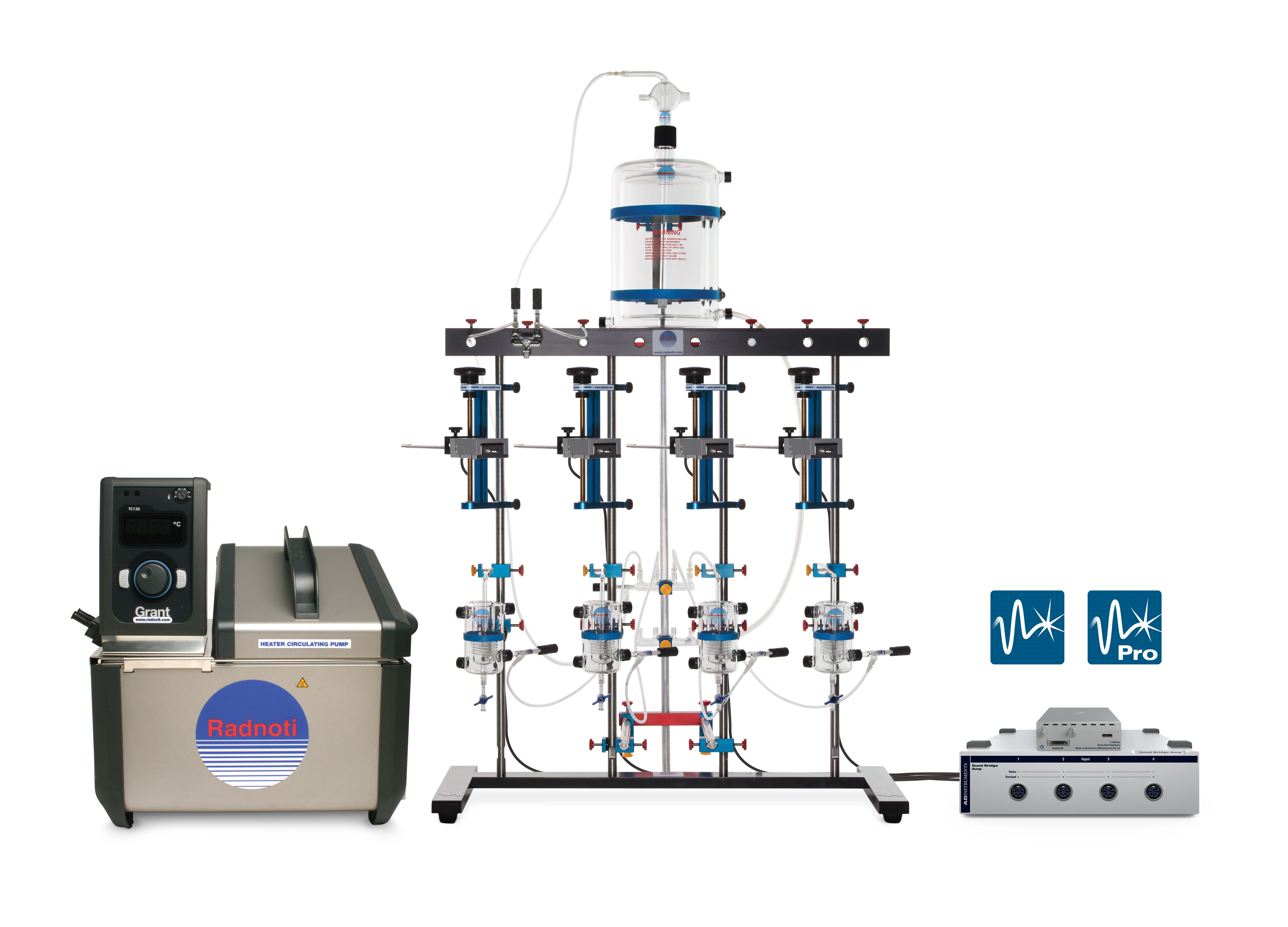
1
2
3
4
5
6
7
8
9
10
Thermal Bath/Circulator allows temperature control in the range from ambient temperature to 120°C.
1660 Series Hi-Tech Tissue Organ Bath comes in a variety of sizes, is water-jacketed, and provides a port for an oxygenating tube similar to the 1583 Series. However, this chamber series also offers a separate fill port with a warming coil, and an overflow port for plumbing into the system's overflow circuit to prevent the perfusate from overflowing the chamber.
*25 mL pictured
Alternative options:
1585 Series Tissue Bath with Built-In Electrodes
The standard Radnoti borosilicate glass tissue hook, which are available in a range of sizes to suit different Tissue Organ Bath sizes.
Also available:
Tissue Ring Supports designed specifically for mounting tissue ring samples such as aortic, intestinal, vascular, or tissue ring segments.
Tissue Clips designed to simplify the tedious task of mounting a sample tissue to a tissue hook and a force transducer.
Platinum Stimulating Electrodes: A wide range of field stimulating electrodes are available.
Two-Way Teflon Needle Valve "Y" Manifold splits a single gas source to two gassing lines and is used to balance the gas flow between different oxygenation circuits. Used in most Radnoti systems.
Oxygenating Bubbler with perfusate inlet port for water-jacketed reservoirs. Provides ports for attaching overflow circuits to flow back into the reservoir, oxygenates the perfusate in the reservoir, and vents the reservoir. Used with all Radnoti systems and offered in a variety of sizes to match different sized reservoirs.
Water-Jacketed Reservoir used to store, warm, and oxygenate perfusate for the perfusion circuits. Offered in a variety of volume sizes, and used with all Radnoti systems.
*2 Liter pictured
Sensitive isometric force transducer, ideal for isolated tissue studies where small forces up to 20 g are expected.
Also available:
Force Transducer (0-2g)
LabChart and LabChart Pro Software
Creates a platform allowing you to acquire biological signals from multiple sources simultaneously and apply advanced calculations and plots.
A four-channel, non-isolated bridge amplifier designed to allow a C Series Front End Inteface or traditional PowerLab to connect to most DC bridge transducers.
Converts analog data from existing (and majority of legacy) ADInstruments Front-Ends such as Bridge Amps and Bio-Amps, so that they can be digitally sampled by the PowerLab C.
- Each apparatus is constructed from individual components, enabling it to be expanded or contracted as needed.
- A wide range of tissue-organ bath chamber styles and sizes are available.
- The Radnoti Quick Disconnect design in the temperature maintenance circuit allows for easy dismantling of glassware for cleaning.
- Made from the highest quality crystal clear borosilicate glass. This glassware is chemically inert, scratch and corrosion resistant, and fully autoclavable.
- The apparatus stands use medical-grade 316 stainless steel base and support rods, providing enhanced corrosion resistance especially in experiments using saline or chloride.
- Double-walled or water-jacketed to maintain a consistent temperature.
- Perfectly sculpted luer ports that minimize leaks, including some lockable luer ports for more secure attachments.
Beyond being a highly customizable apparatus, the Radnoti Tissue-Organ Bath Systems are also compatible with a wide range of accessories. These accessories include:
- tissue hooks and supports in various sizes, styles, and alloys
- stimulating platinum electrodes
- a wide range of water heaters via the supplied interface connectors, and
- Compatibility with the existing PowerLab hardware and LabChart software, for straightforward data acquisition.
- The initial price of the apparatus is higher than a compact apparatus.
- Glassware, while sturdy, is more fragile than plastic.
- Setting up a modular system can be daunting compared to a compact system.
- A separate heated water circulator is needed to maintain water temperature.
Panlab (Harvard Apparatus)
Panlab, a brand within Harvard Apparatus, produce a compact 4-chamber organ bath. This system is optimized for cost-effectiveness and space efficiency. The chambers of the organ bath are fully enclosed in an outer tank, which is then filled with heated water to maintain the temperature of the chambers. For labs with limited space and budgets, this could be an appropriate choice.
- The apparatus is relatively compact.
- Compatible with 5, 10, 25, and 50ml chambers.
- Safety sensors for both water level and temperature.
- The position of the heating coils next to the chamber provides heat exchange before reaching the tissue sample.
- Electronic switches control the opening and closing of valves for buffer filling and emptying.
- All chambers can be filled or emptied simultaneously.
- All chambers have overflow ports.
- There is an additional gas outlet to supply oxygen to chambers within the apparatus.
- The perspex used for the outer tank in likely to wear and become opaque over time.
- Buffer droplets can spill into the heated water, increasing the risk of algae or bacterial growth.
- Not autoclavable.
- The buffer reservoir needs to be purchased separately, requires its own water jacketed heating and to be gassed.
- The external thermocontroller takes up bench space.
- There are limited tissue mounting and stimulating accessories available for this apparatus.
- The metallic tissue hooks can rust.
- A damaged or worn-out part of the apparatus cannot be switched out. The entire system would have to be repaired or replaced.
Biopac Systems Inc.
Biopac produces the TISSUEBATH1, a single unit tissue-organ bath, available as a single unit or in 2, 4, and 8 chamber multiples. The TISSUEBATH1 is a discrete unit, with every part of the apparatus stacked and independent of the other units in a larger apparatus set up. In a way, the design is modular, in that individual TISSUEBATH1 modules can be added or removed from the apparatus, however the subcomponents within each unit are not modular. The isolation of each unit from one another increases the complexity of adding and removing units, and the risks of temperature fluctuations between units.
- Each unit is relatively compact with independent reservoirs.
- The tissue positioner has a micrometer control.
- The apparatus base has grooves to minimise the impact of spills.
- Relatively inexpensive.
- Only the tissue bath and warming coil appear to be glass. The plastic buffer reservoir will likely wear and become opaque over time.
- Use of plastic in the clamps can cause them to loosen and break over time.
- The buffer reservoir is not water-jacketed, and has no gas bubbler.
- The buffer reservoir has a small volume, limiting the number of repeats before each refill.
- The individual buffer reservoirs each require attention and increase the risk of differences being introduced to the tissue environment.
- More connections are needed for water heating due to units having individual reservoirs.
- There is increased risk of non-uniform heating due to heated water travelling greater distances and being split among multiple units.
Scientific Glass Blower
Most scientific institutions employ or have access to one or more scientific glass blowers. These highly specialized technicians sculpt scientific instruments from borosilicate glass. This differs from traditional glass blowing as borosilicate glassware has a much higher molten state temperature and is, therefore, more expensive to produce. The higher concentration of silica and boron oxides in the glassware makes it less fragile than typical glass, chemically inert, and thermally stable enough to be formed into complex structures, repaired, and modified after its initial production.
Scientific glass blowers are experts in their field and crucially important for the production of complex, one-off, and proof-of-concept laboratory equipment. When it comes to troubleshooting glassware they are a valuable resource, but if the troubleshooting blurs into the technical aspects of your research they do not have the expertise to assist in diagnosing the issue.
- Can provide borosilicate glassware to your specifications and designs.
- Can adjust, repair, or modify borosilicate glassware.
- Cannot provide non-glassware components to complete the system.
- Cannot provide technical assistance for experimental set up or troubleshooting.
- Lifespan of the product unclear - if problems start to occur with the system due to an irregularity in the glassware it can be hard to diagnose.
- If the glass blower retires, or the institution disestablishes their department, then you’re back to square one.
- Difficult to integrate with an off-the-shelf system if expansion is ever needed.
Tissue-organ bath systems aren't a 'one size fits all' product. The needs of each lab dictate the kind of system that will work best for you. The flexibility and high-quality materials of the Radnoti Tissue-Organ Bath system, however, allow it to take on whichever form your research requires. If you're looking for a system that will provide consistent, reliable results, a system that grows and changes with your research, a system designed with researchers in mind; you're looking for Radnoti.